

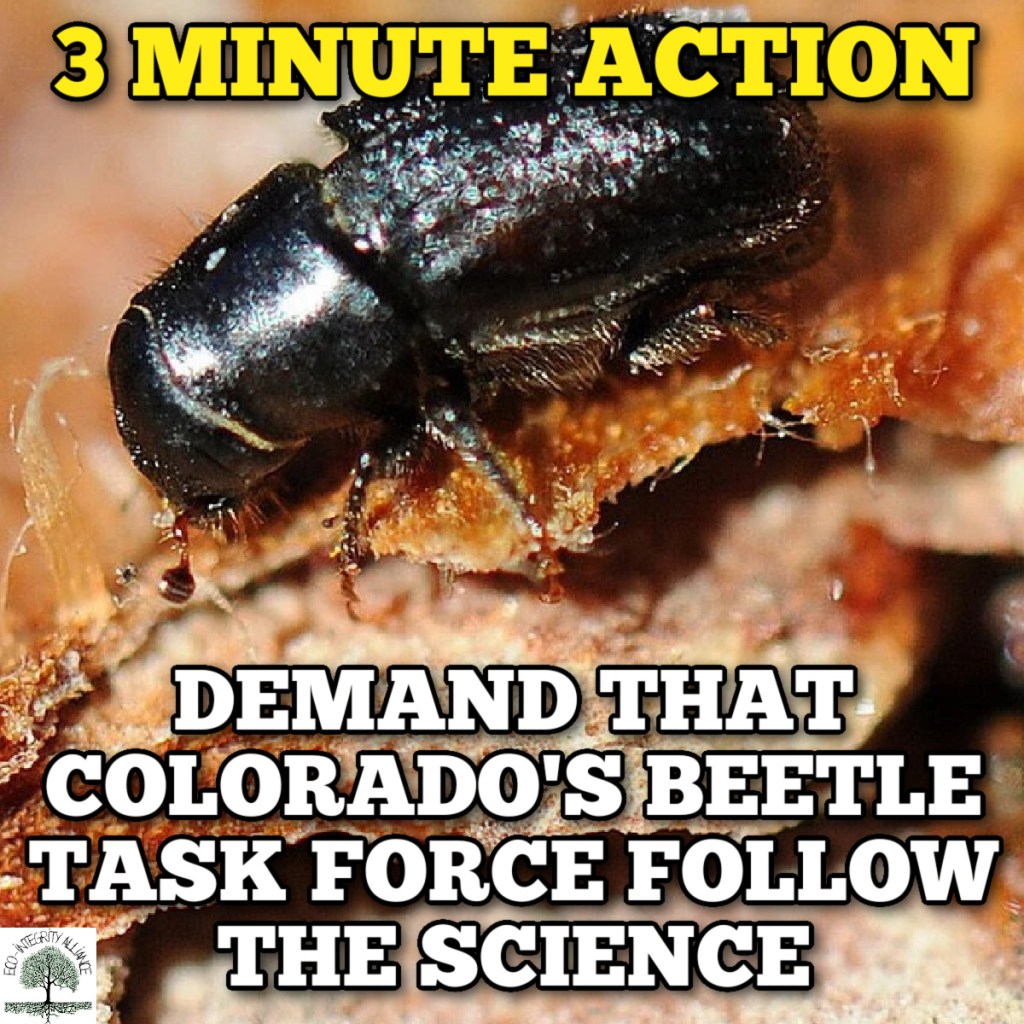
Please consider taking 3 minutes to contact Colorado’s “Ponderosa Mountain Pine Beetle Task Force” and demand that it stop exploiting native insects unrelated to wildfire to promote a pre-determined public lands logging agenda.
Background:
Formed in December 2025 by Governor Jared Polis in reaction to the latest natural wave of native mountain pine beetles in Front Range forests, the Task Force is made up almost entirely of representatives from industries, governments, agencies, and NGOs that carry out and/or promote controversial, scientifically contested, experimental “fuel reduction” logging on public lands, financed by millions in annual taxpayer dollars.
The Task Force’s new “Comprehensive Work Plan” makes zero mention of the consensus of peer-reviewed science—including from CU Boulder and Colorado State University—“refut[ing] the assumption that increased bark beetle activity has increased area burned” or finding how “large patches of beetle killed trees are generally less flammable at broad scales, not more so.” (more studies here).
On the contrary, the Work Plan reveals that the Task Force intends to demonize beetles—and the ecologically-essential forest structure and wildlife habitat they create—to further whip up fire hysteria among elected officials, media, and the public to expand taxpayer funding for more logging than Colorado has seen since the gold rush. For more details read Eco-Integrity Alliance’s assessment of the Task Force’s Work Plan.
Take Action:
Please contact the Beetle Task Force today using this form with your own message based on the scientific studies below or simply: “I ask the Task Force to please follow the consensus of peer reviewed science showing no link between beetles and an increase in landscape-wide wildfire risk or severity. If the Task Force’s goal is community and forest protection, instead of promoting more ecologically-harmful logging which has no effect on large waves of beetles, it should push for policy for ending extraction on public lands and funding home hardening grants for low-income, disabled, and elderly Coloradans.”
Excerpts from peer-reviewed studies:
–Removing dead trees will not save us from fast-moving wildfires by Dominick DellaSala, et al., PNAS, 2025
“Thus, studies report no detectable changes in the likelihood of fire or area burned in beetle-affected snag forests. In general, research suggests that large patches of beetle killed trees are generally less flammable at broad scales, not more so.”
–Mountain Pine Beetle in Colorado: A Story of Changing Forests by Jose F. Negron et al., Journal of Forestry, 2018
“A spatial analysis of 466 fires (all but one less than an acre) from 1980 to 2005 did not find a relationship between MPB-caused mortality and subsequent fires. Kulakowski and Jarvis (2011) examined burned and unburned lodgepole pine stands and indicated that beetle-caused mortality did not increase fire probability. Observed fires were driven by climatic factors that foster dry conditions, which is consistent with previous studies.”
–Do insect outbreaks reduce the severity of subsequent forest fires? by Garrett W Meigs, et. al., Environmental Research Letters, 2016
“In contrast to common assumptions of positive feedbacks, we find that insects generally reduce the severity of subsequent wildfires…By dampening subsequent burn severity, native insects could buffer rather than exacerbate fire regime changes expected due to land use and climate change.”
–Area Burned in the Western United States is Unaffected by Recent Mountain Pine Beetle Outbreaks by Sarah J. Hart, Tania Schoennagel, Thomas T. Veblen, Teresa B. Chapman, Proceedings of the National Academy of Sciences (PNAS), 2015
“Contrary to the expectation that an MPB outbreak increases fire risk, spatial overlay analysis shows no effect of outbreaks on subsequent area burned during years of extreme burning across the West. These results refute the assumption that increased bark beetle activity has increased area burned.”
–Management for mountain pine beetle outbreak suppression: Does relevant science support current policy? by Diana L. Six, et al., Forests, 2014
“Doing the math, we find that once the beetles have run their course, more residual living trees (100) actually remain in the control plot than in the thinned plot (90) and, in fact, humans have contributed more to tree mortality than have the beetles.”
“Six found higher numbers of mature living trees remained in control stands of ponderosa pine than in thinned stands post-mountain pine beetle outbreak.”
–Do Bark Beetle Outbreaks Increase Wildfire Risks in the Central U.S. Rocky Mountains? Implications from Recent Research by Scott H. Black, Barry Noon, et al., Bio One, 2013
“Preemptive thinning may reduce susceptibility to small outbreaks but is unlikely to reduce susceptibility to large, landscape-scale epidemics. Once beetle populations reach widespread epidemic levels, silvicultural strategies aimed at stopping them are not likely to reduce forest susceptibility to outbreaks. Furthermore, such silvicultural treatments could have substantial, unintended short- and long-term ecological costs associated with road access and an overall degradation of natural areas.”
“Post-disturbance harvest is common practice on forest lands and is designed to remove trees or other biomass in order to produce timber or other resources. This type of resource extraction has the potential to inadvertently lead to heightened insect activity.”


Leave a Reply