


-Opinion by Josh Schlossberg
In my twenty-five years of interfacing with elected officials as a public interest advocate, Jefferson County Commissioner and candidate for Lieutenant Governor, Lesley Dahlkemper, has been the most anti-democratic I’ve come across.
Whether it’s routing tax dollars to expand government control, ignoring the consensus of peer-reviewed science, or dismissing constituent concerns out of hand, Dahlkemper’s seeming indifference to—or even scorn for—participatory democracy is the reason I left Jefferson County and filed a lawsuit against her for what I believe to be violations of the Colorado Open Records Act.
After what I’ve seen of the conduct of this career politician (and having heard the same from nearly every person I know who’s engaged with Dahlkemper), I feel obligated to share some of the evidence I’ve compiled so the Phil Weiser campaign and Coloradans alike can make an informed decision as to whether or not they want to her as the second most powerful person in the state.
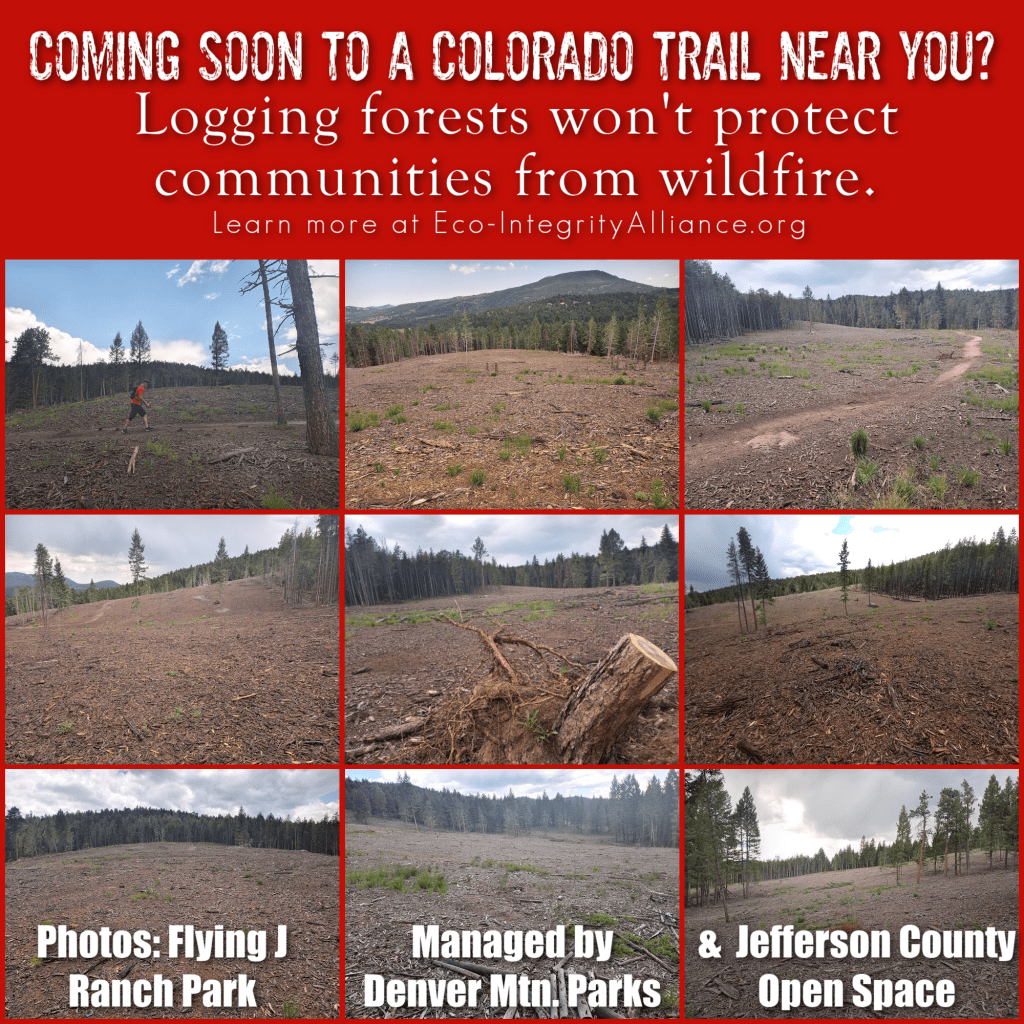
As Chair of the Jefferson County Board of Commissioners, Dahlkemper siphoned huge sums of taxpayer dollars into bloated government agencies, corporate welfare, and dangerous, cut-rate teen and prison labor to—according to an abundance of peer-reviewed science—likely increase the risk of wildfire to communities by logging Jefferson County’s forests, heating them up, drying them out, and opening them to wind, the main vectors of fire spread.
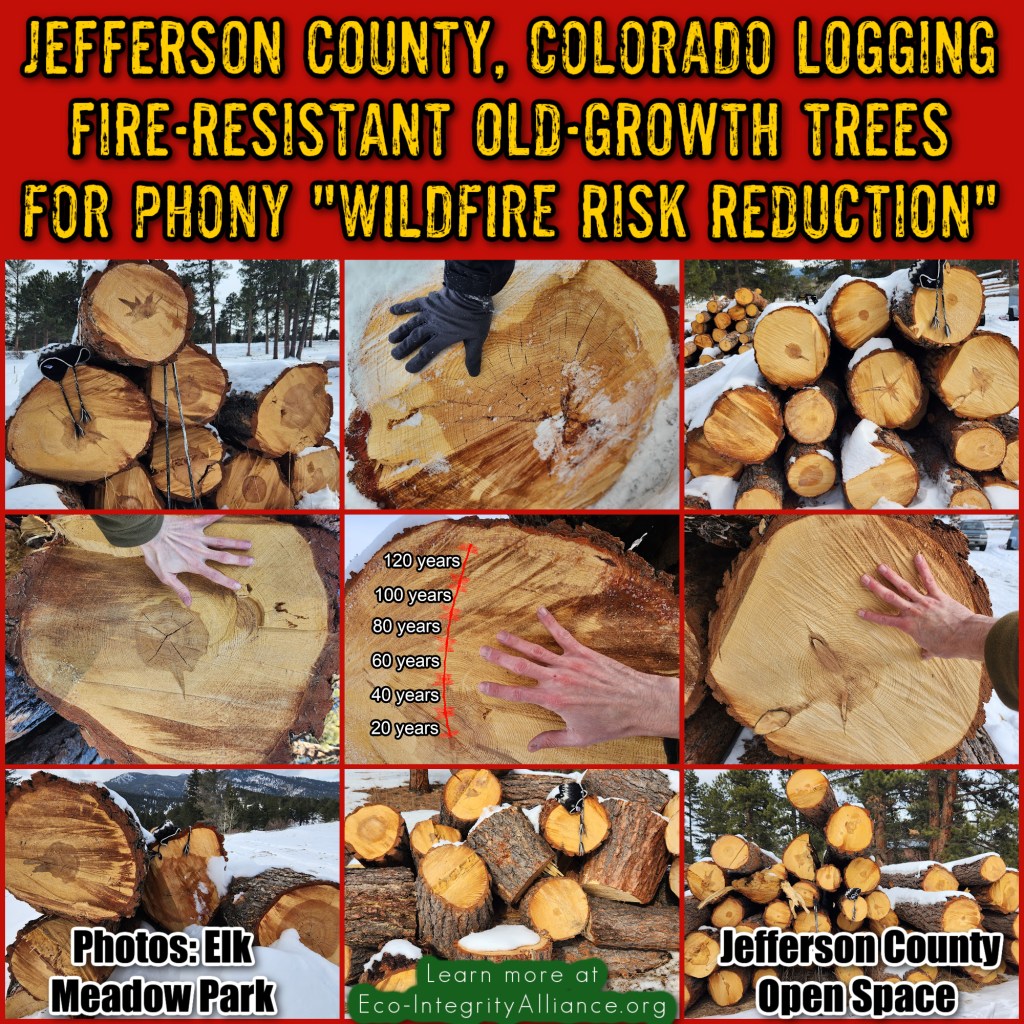
Dahlkemper has overseen schemes for thousands of acres of taxpayer funded industrial logging, including clearcutting and removing trees up to 211 years old, across the Front Range’s most treasured Open Space while sidestepping meaningful engagement from the scientific, conservation, and local community. Dahlkemper has made Jefferson County infamous across not just Colorado but the entire western U.S. for her aggressive public lands extraction.
Whether or not you support the most wildlands and wildlife destruction Colorado has seen since the gold rush, the scientific consensus concludes that forest “fuel treatments are not designed to prevent or stop fires but to moderate fire behavior when fire inevitably returns,” yet, crucially, “are unlikely to mitigate fire severity during extreme weather,” the only time fires seriously threaten communities.
Science aside, surely anyone who believes in democracy must agree that the public should have at least some say in what happens on our publicly owned lands? Because if Dahlkemper isn’t open to feedback on an issue as crucial to Coloradans as nature, recreation, and protecting our property and lives, why would she be for any other?
To the contrary, not only has Dahlkemper put up roadblocks to civic engagement, not only has she dismissed every single concern about her heavy-handed mismanagement of public lands, not only is she in the proven habit of deleting constituent emails, evidence obtained through Colorado Open Records Act (CORA) filings suggests she has both investigated and defamed private citizens who dare to disagree with her.
From my perspective, this isn’t simply about Dahlkemper pushing policies I—and the majority of her constituents who see the aftermath of her logging—don’t like. It’s about a politician who appears to be either unwilling or unable to consider any perspectives other than her own as remotely valid or even good faith, but instead to see such views—and the constituents who hold them—as nothing but obstacles in her way.
Below I’ll reveal some of the details (corroborated by documentation) of what I see to be Dahlkemper’s concerning behavior in office as a public servant which I hope voters will consider in the upcoming election.
False statements on public record:
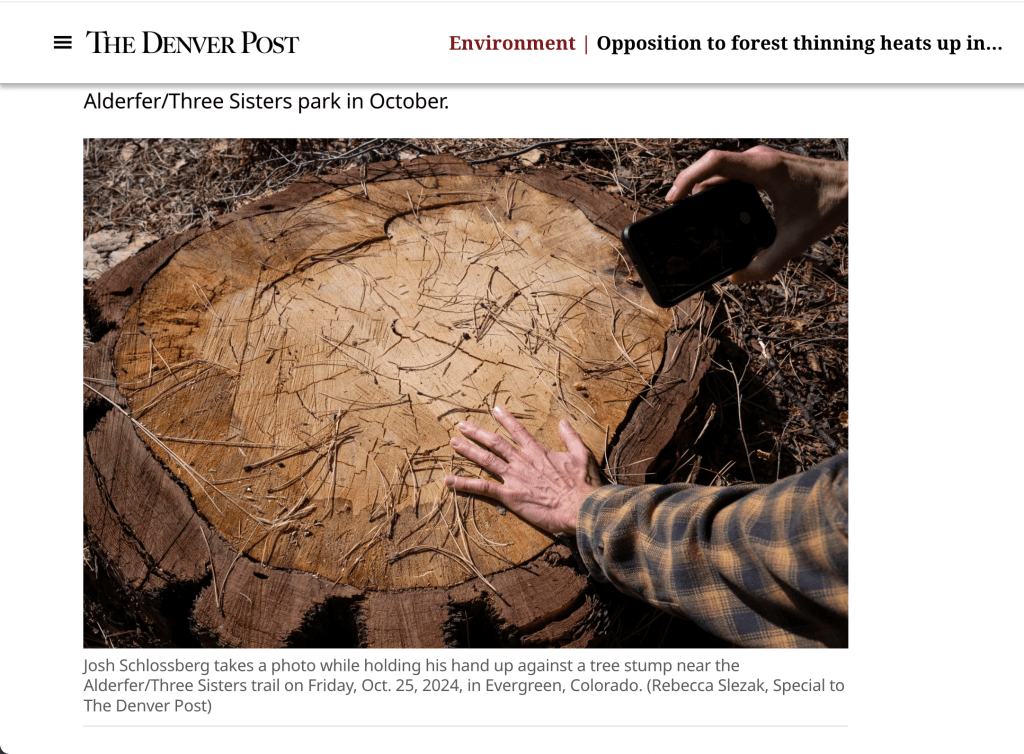
Dahlkemper ignored emails with photographs of trees up to 129 years old logged from Jefferson County Open Space. At a town hall in Evergreen in February 2023, after being presented with hard copies of these photos, Dahlkemper denied it was happening on video.
Since then, scores of photos of mature and old growth trees up to 211 years old logged out of Jefferson County Open Space have been taken and published by Denver Post, other media outlets, and across social media. Yet, to this day, Dahlkemper still refuses to correct the record.
Defaming private citizens to media:
In April 2025, an editor of a local media outlet emailed me to ask why Dahlkemper had said that I was mispresenting myself as a journalist for that publication. This is, of course, an allegation that would seriously harm my advocacy work which requires credibility with media. While I had freelanced for this editor as recently as 2021, I hadn’t claimed otherwise to anyone, nor would I have anything to gain—indeed, much to lose—as an outspoken activist on forest issues.
I had, however, gotten multiple media outlets, including the one mentioned above, to report on Dahlkemper’s egregious forest destruction. Later, a Colorado Open Records Act (CORA) filing uncovered emails proving government and corporate logging interests to be regularly contacting media to disparage scientists and critics as untrustworthy.
Investigating citizens:
Worried about how Dahlkemper was apparently defaming me to reporters, I decided to file a CORA request for any Jefferson County government emails containing my name and my grassroots group, which returned an astonishing 769 results. In the CORA return, I learned many disturbing things about Jefferson County and partnering logging interests suppressing science and public criticism (while privately admitting the validity of such) and targeting scientists and advocates, which can be found in Eco-Integrity Alliance’s Forest Fire Malfeasance report.
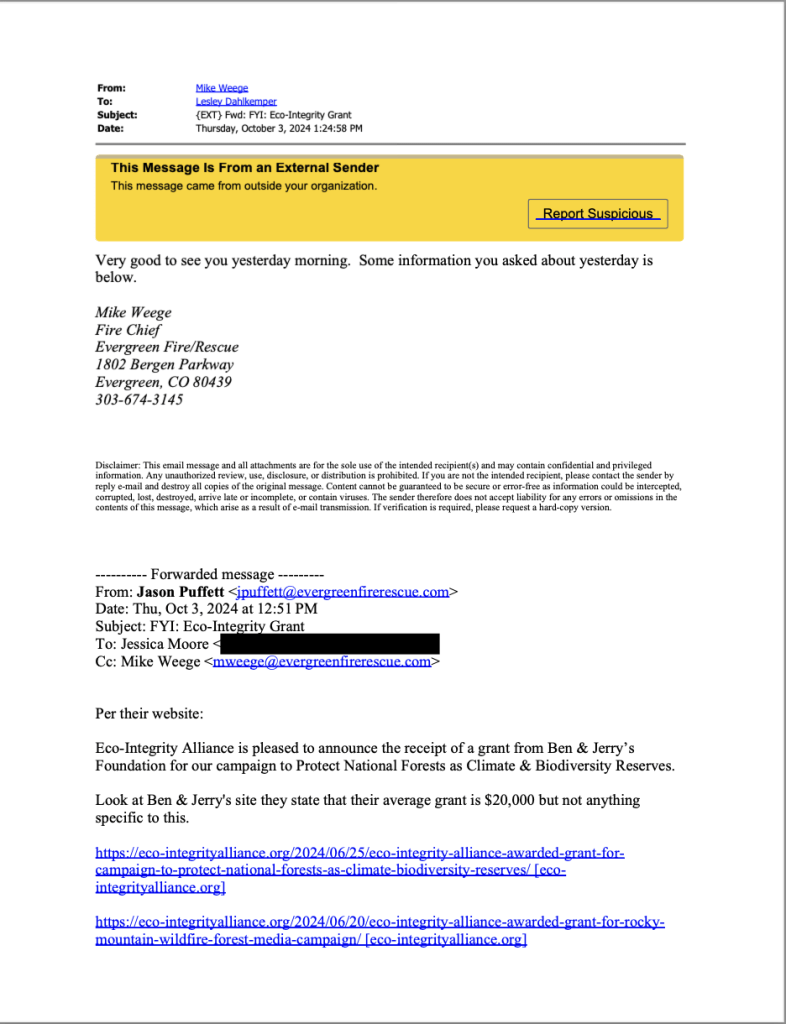
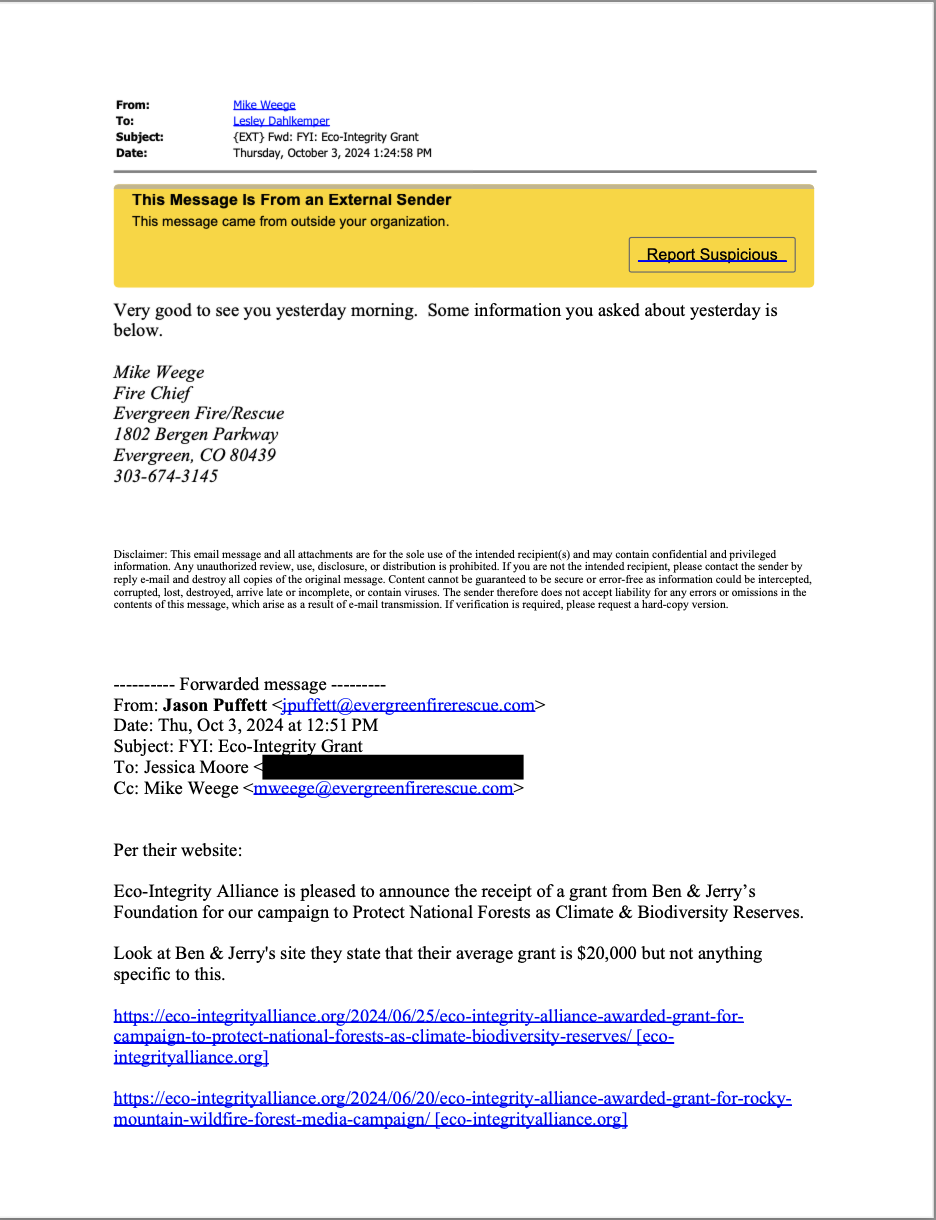
Most alarming, however, was an email from October 2024 in which the Evergreen fire chief responded via email to Dahlkemper saying, “Some information you [Dahlkemper] asked about yesterday is below.” The email contained details about me, my grassroots group, and one of our foundation funders. Especially concerning was the fact that neither an original email from Dahlkemper nor any reply was included in the CORA return.
Deleting emails:
Indeed, the CORA return was equally glaring for what it didn’t contain. Namely, no more than a handful of emails from Dahlkemper despite being Jefferson’s County’s staunchest proponent of “fuel reduction” logging and sitting on the state’s Colorado Fire Commission.
However, the CORA did prove for a fact that Dahlkemper was in the habit of deleting emails she’d previously received based on her own admission.
In 2022, Eco-Integrity Alliance launched a Change.org petition asking Dahlkemper and the other two Jefferson County Commissioners to pause logging until the full spectrum of science and public opinion was considered. The petition received a total of 839 signatures, most in 2022, the rest trickling in through 2025.
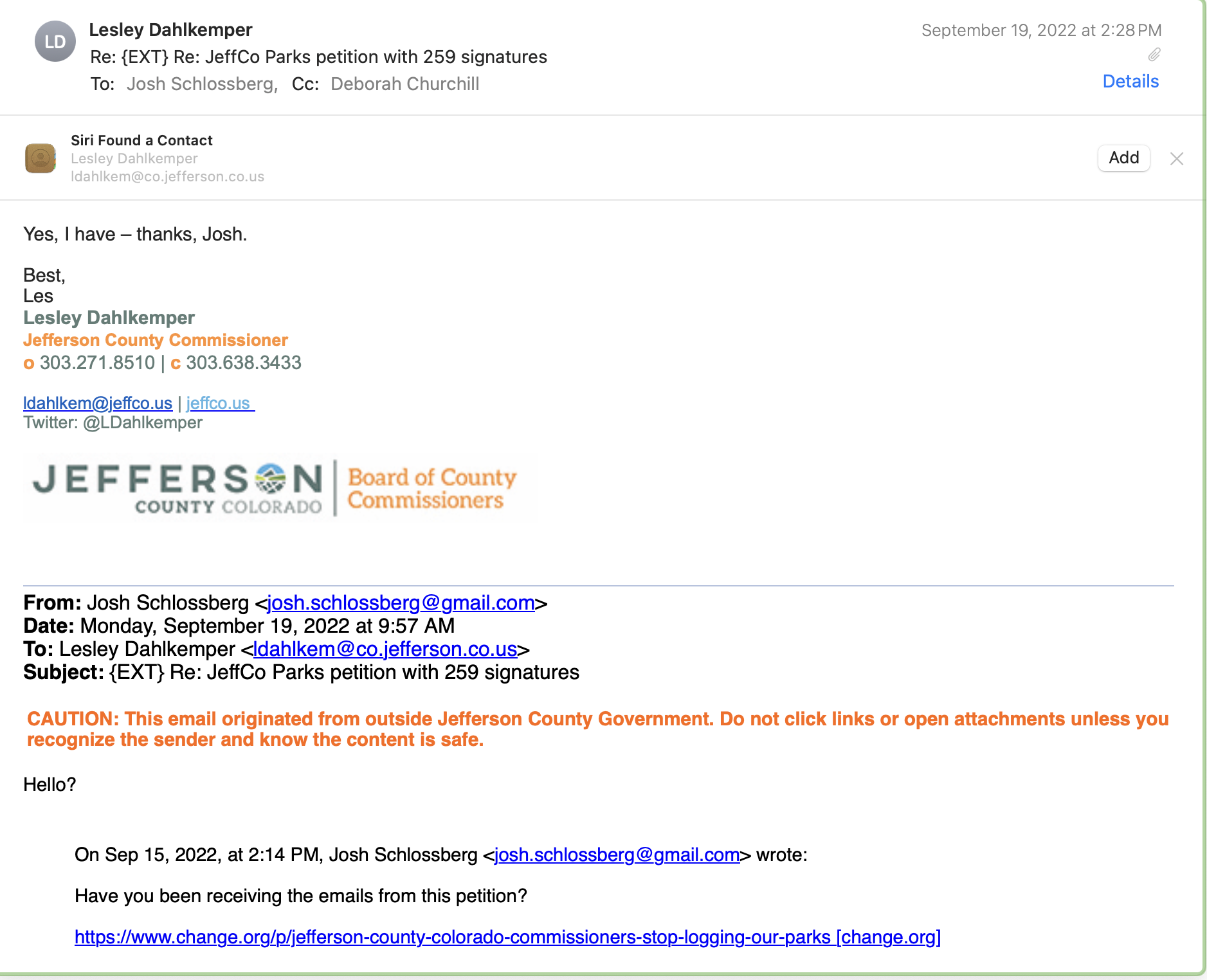
Change.org regularly emails decision makers with the latest signatures. Since Dahlkemper chose not to respond to the petition, I sent an email in September 2022 asking her if she’d received the latest signatures, to which she replied “Yes, I have.”
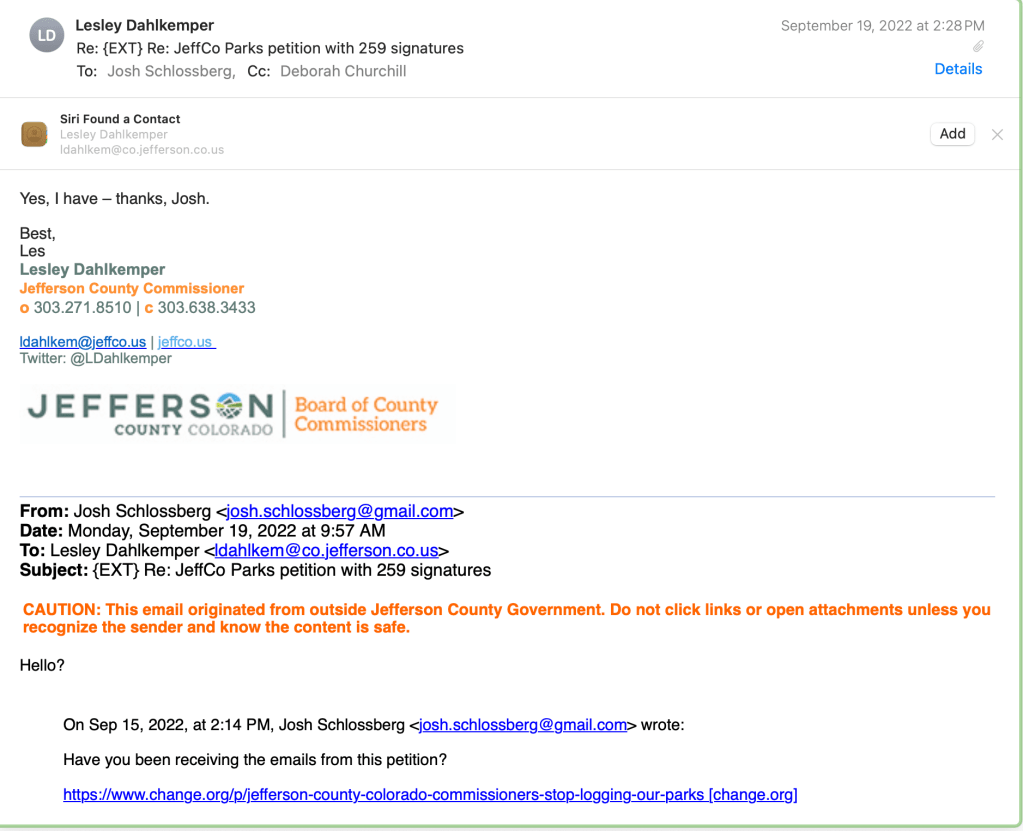
Strangely, for whatever reason, those original petition emails and the ones that continued to trickle in over three years were missing from the CORA. In other words, Dahlkemper had deleted them.
While unfortunate for an elected official to send petitions to the trash—I believe speaking volumes as to how Dahlkemper treats constituent feedback—in the State of Colorado an elected official is allowed to delete routine emails under certain circumstances so long as no CORA filing requests them.
However, Colorado Revised Statutes Title 24 says that CORA’s application to “‘Public records’ includes the correspondence of elected officials.” In particular, communications related to “exercise of functions required or authorized by law or administrative rule,” in this case, Dahlkemper making policy to carry out logging on Jefferson County Open Space. Further, such policy wherein Jefferson County staff or contractors carry out logging also does, as the statutes dictate, “involve the receipt or expenditure of public funds,” both in terms of sales tax in Jefferson County, state funding, and federal funding.
Even barring these circumstances, the absence of the petitions in the CORA return proved that Dahlkemper has an established practice of deleting emails. Which is what led me to suspect that she had illegally disposed of other emails relevant to the issue, including possibly after my CORA filing.
Likewise, my follow up CORA requests for Dahlkemper’s personal emails on “fuel reduction” and similar keywords returned zero emails, highly unusual for someone so prominent on the issue.
Lawsuit filed against Dahlkemper for alleged CORA violations:
After the County claimed there were no more emails, I filed a lawsuit in district court against Dahlkemper for what I (still) believe to be a violation of CORA.
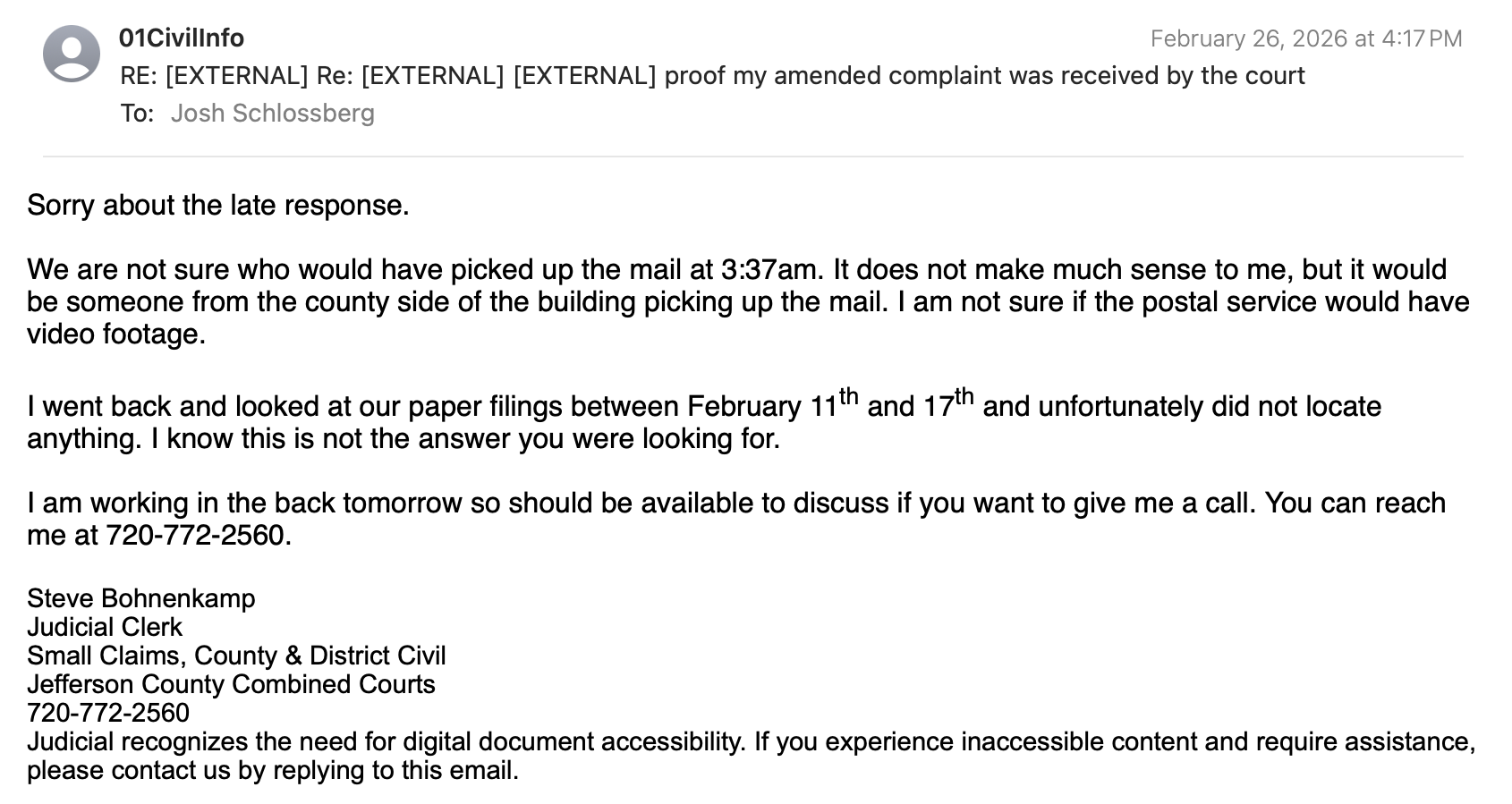
During the process, important documents I sent certified mail to Jefferson County District Court were, according to a court clerk, intercepted by unnamed Jefferson County staff, the very entity I was suing. In the first instance, a crucial document I sent weeks before deadline wasn’t filed with the court because of the interception, which prevented me from being able to bring up those central issues at a pre-trial hearing before the judge.
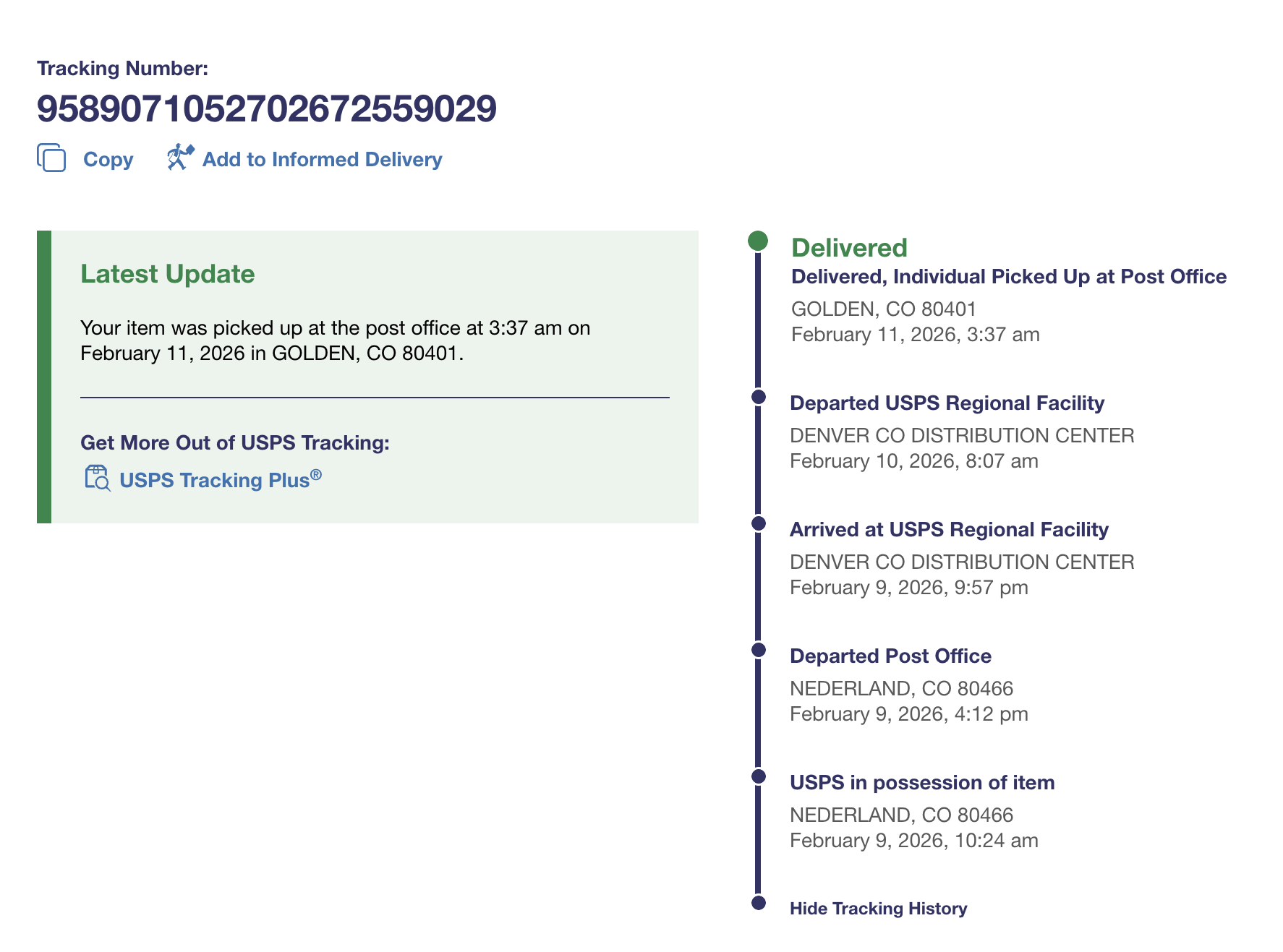
A U.S. Postal Service investigation discovered that the document was delivered to the County Building on February 11 and picked up by an unknown person at 3:37 a.m. All my requests to uncover the name of the individual who intercepted my document went unanswered by Jefferson County, and Jefferson County Sheriff Department (which recently got almost $10 million in taxpayer funding for “wildfire mitigation”) refused to investigate the potential mail theft.
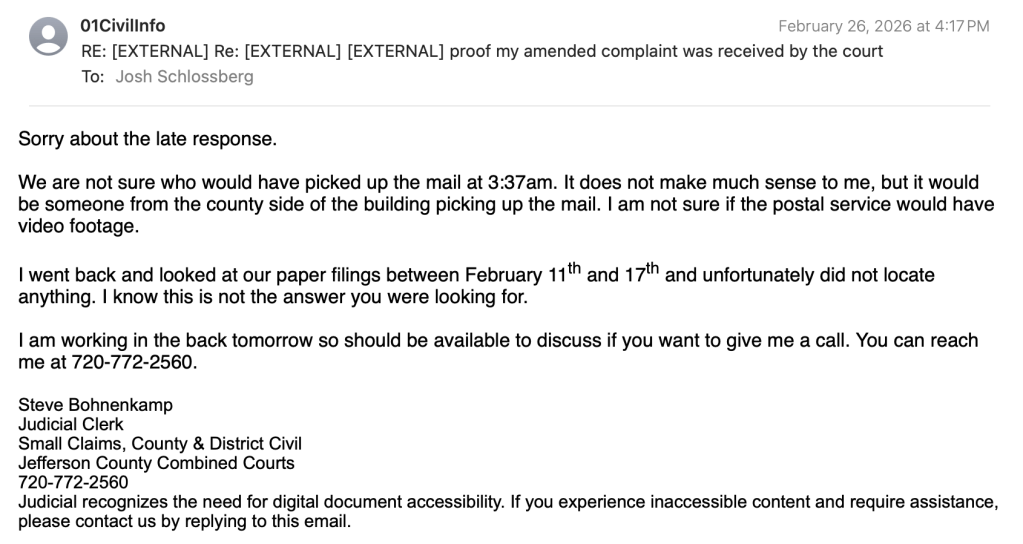
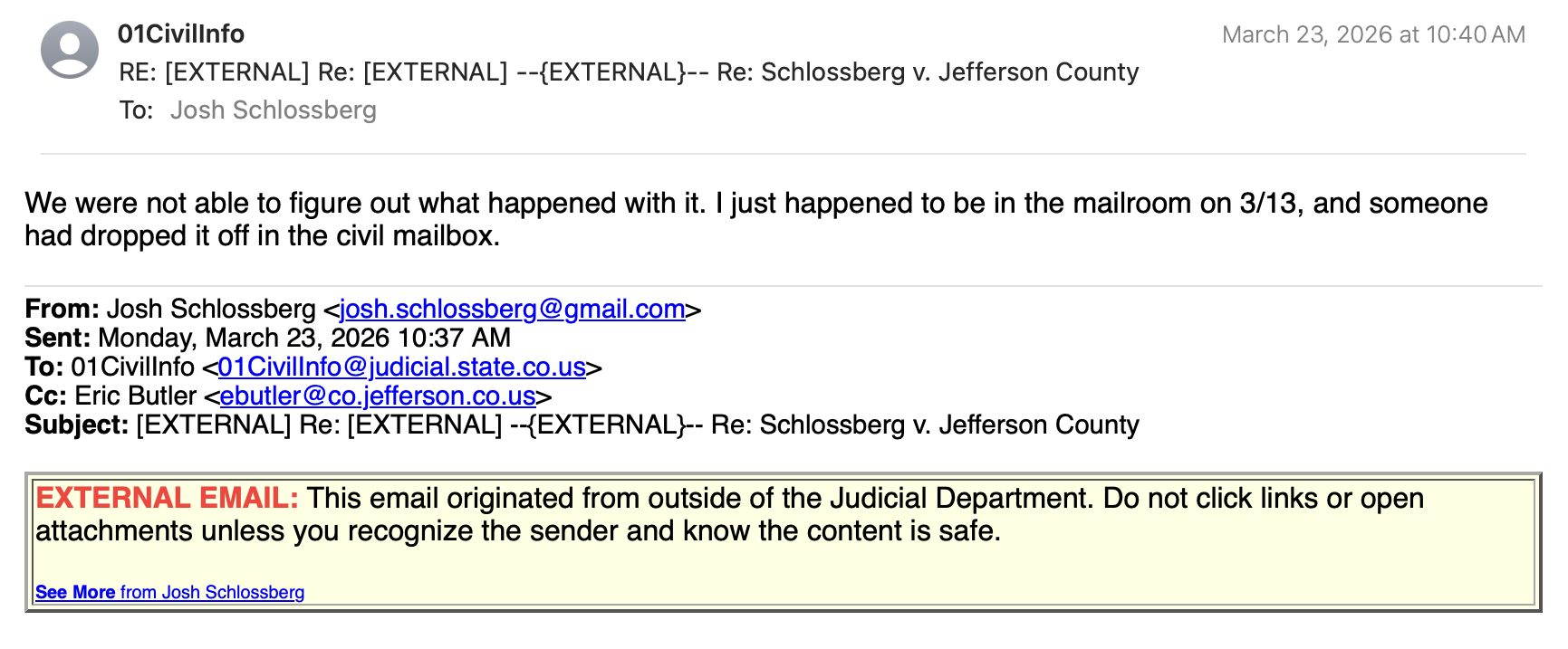
Oddly, the document turned up a month later without any explanation, with the court not knowing who delivered it and the county refusing to tell me. Weeks later, another document I sent via certified mail nearly a week before deadline was refused by an unknown Jefferson County staffer.
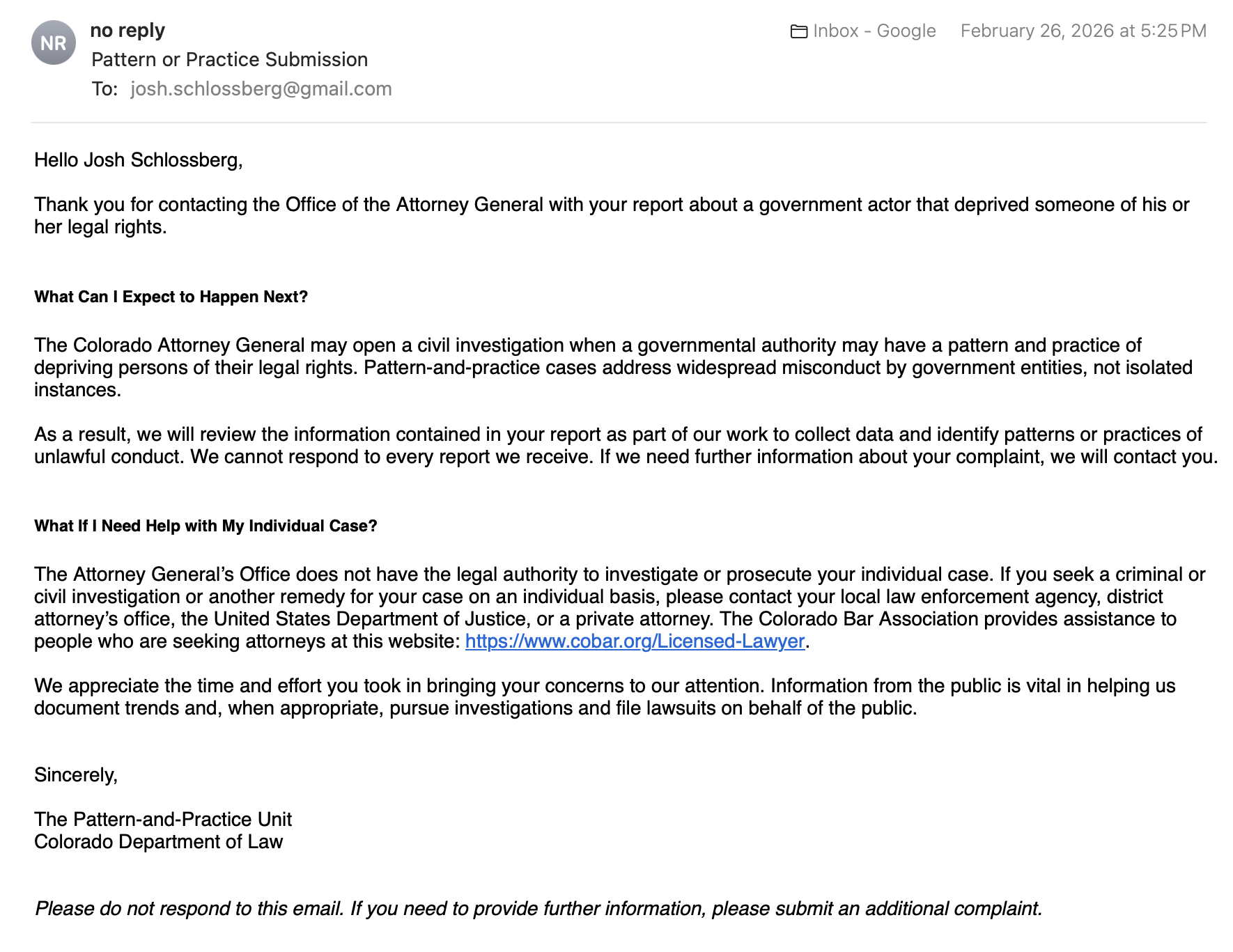
Getting no answers as to why Jefferson County kept derailing my court case, I filed a complaint with Colorado Attorney General Phil Weiser’s office, which replied that I’d need to have multiple incidents for them to investigate. I explained again that there had been two incidents yet never heard back again from Weiser’s office.
As the hearing drew closer, Dahlkemper—through her Jefferson County attorneys—both denied she’d deleted the emails in question while contradictorily claiming that if she had it was legal. I finally realized that if I won the case, Dahlkemper would still probably deny the existence of the emails, and if I lost the county would demand I pay her attorney fees.
Not wanting to take up any more of the court’s time—another Jefferson County entity I no longer trusted—I withdrew my complaint. Perhaps most distressing was my request for Dahlkemper to agree not to defame me to media nor contact my funders was refused outright.
Dahlkemper testified against protecting homes from wildfire to fund more logging:
In March 2026, Dahlkemper testified against a statehouse bill that would’ve directed a percentage of taxpayer funding currently spent almost exclusively on at-best-questionable logging in the name of “wildfire mitigation” to the one practice scientifically proven to protect homes and lives, home hardening.
The bill would’ve merely required that the Colorado Department of Natural Resources follow its legal mandate to “prioritize those projects with the greatest potential to protect life, property, and infrastructure,” namely home hardening in the form of grants to low-income, elderly, and disabled Coloradans most at risk from wildfire.
Instead, in her testimony, Dahlkemper insisted that every last available tax dollar continue to finance government agencies, corporations, and well-funded NGOs to carry out scientifically-dubious, ineffective, or even counterproductive logging.

Conclusion:
I’ve tried my best not to take any of Dahlkemper’s actions towards me personally nor do I have any grudge against (or allegiance to) any political party. I’m reporting this evidence out of what I feel to be an obligation and civic duty that the Weiser campaign and the voters of Colorado make an informed decision on Dahlkemper’s track record of engaging (or not) with constituents on crucial matters of public policy that can have serious impacts on our livelihoods and lives.
 The Colorado Smokescreen
Leave a comment