

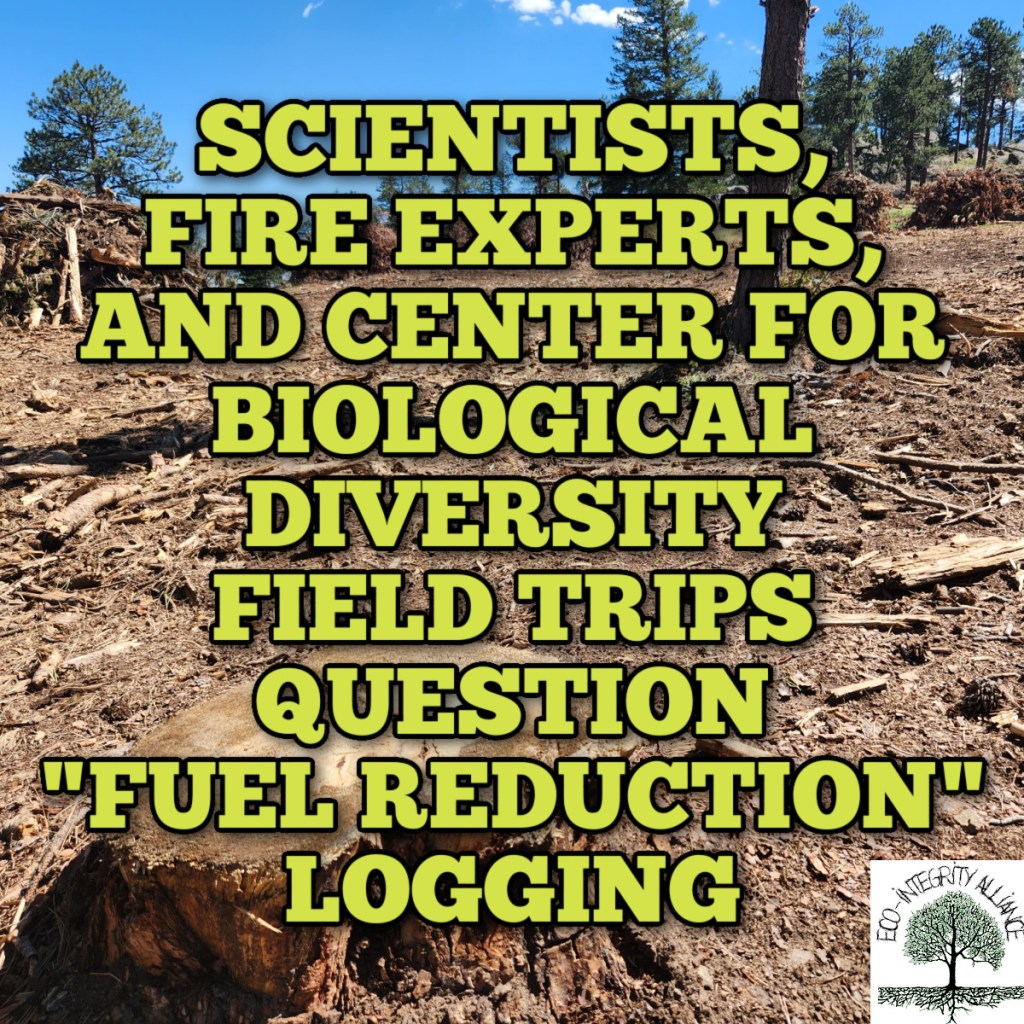
Some of Colorado’s leading scientists, wildfire experts, and some of the state’s most respected conservation organizations are hosting two field trips in June to show the public and media on-the-ground impacts of forest “fuel reduction” and share science questioning the efficacy of or need for these high elevation “treatments.”
A June 10 hike to CU Mountain Research Station in Boulder County will be led by Dr. Tom Veblen, CU Distinguished Professor Emeritus and author/co-author of hundreds of peer-reviewed studies on forests and wildfire, and Karl Ford, former environmental scientist and fire manager for Bureau of Land Management. It’s part of a series hosted by Boulder County Nature Center “to better understand how scientific evidence relates to messages about fire risk and forest management from national and local government and the media.”
On June 17, Center for Biological Diversity will host a field trip in central Colorado’s Chaffee County (starting in Buena Vista and ending west of Salida) with Dr. Veblen, hydrologist and geologist Rebecca Biglow, and forester, arborist, and former wildland firefighter Angie Jenson.
The Chaffee County trip will investigate recent and proposed “fuel reduction” logging sites including U.S. Forest Service’s “Monarch Pass Forest and Watershed Health Project,” “Methodist Front Wildland Urban Interface Forest and Watershed Health Project” Poncha Springs pinyon-juniper mastication site, and the proposed “Bald Mountain Forest Health and Hazardous Fuels Reduction Project” along the Colorado Trail.
The Center for Biological Diversity invitation says that “scientific evidence does not show that these projects effectively or consistently have reduced wildfire risk, particularly in the context of increasingly extreme fire weather. In fact, a vast body of fire ecology research challenges many of the assumptions behind these projects and shows these approaches do little to address the conditions that make wildfires deadly to people and destructive to communities. In fact, logging and mastication may actually make things worse.”
The itinerary asks, “Do we have enough scientific evidence to justify widespread adoption of these methods, or is more careful study needed before moving forward?”
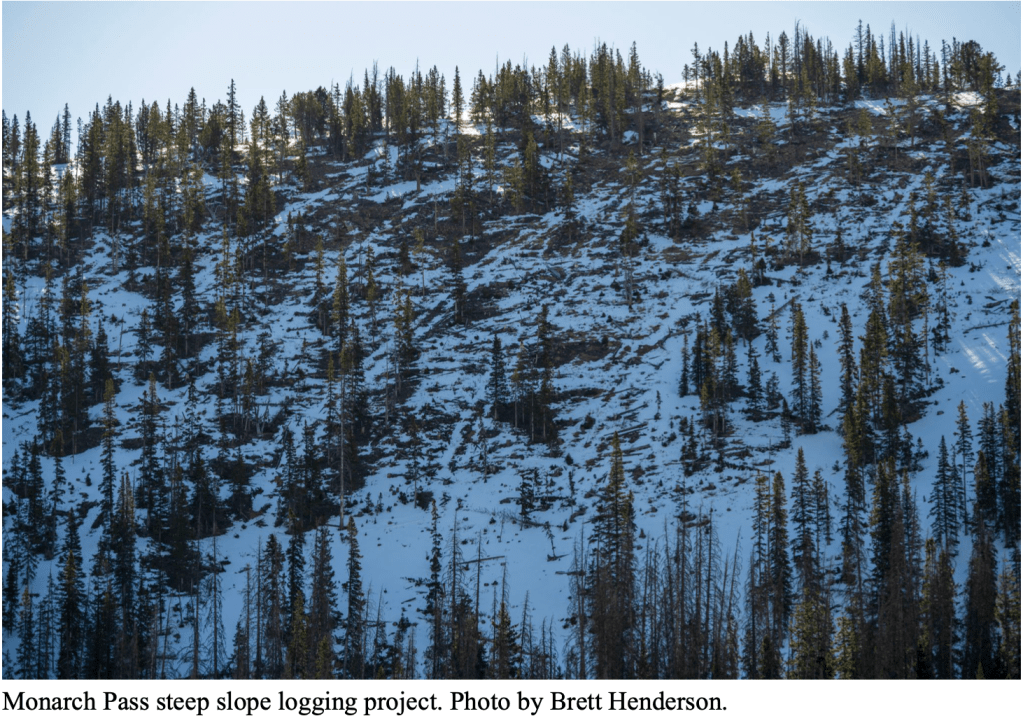
“Fuel reduction” logging projects are underway or proposed for millions of acres across Colorado (over one hundred million acres of public lands across the West—59 percent of National Forests—are under an “emergency” designation to fast track logging). This includes nearly a half-million acres as part of the “Big Four” scheme in the Front Range, which involves clearcutting, logging in endangered species habitat, Roadless Areas, and old-growth forest.
Billions of dollars are spent every year by industry, government, NGOs, and foundations to both carry out and promote typically ineffective or counterproductive “fuel reduction” logging in public forests as the primary response to protecting communities from wildfire instead of effective home hardening. This, despite the overwhelming scientific evidence showing such cutting does not prevent the spread of fire to communities nor even reduce high-severity wildfire (a natural process).
A concerted industry, government, foundation, and “working lands” NGO campaign to exaggerate threats from wildfire and offer public lands logging as the “solution” has frightened many well-meaning entities—including some in the environmental community—into buying one-sided talking points, distorted misinformation, or outright disinformation to either ignore the impacts of or promote industrial logging.
In March, a bill was introduced into the Colorado state legislature that would’ve shared a percentage of the tens of millions in “wildfire mitigation” taxpayer dollars—currently routed almost exclusively towards logging—with proven-to-be-effective home hardening. After industry, government, and NGO logging interests rallied to axe the bill, the same entities have ramped up their PR campaign to guard their funding.
A ballot initiative sponsored by The Nature Conservancy (which logs public lands at taxpayer expense and has a $1.8 billion budget), Western Resource Advocates, and supported by Conservation Colorado—all three NGOs testified against the aforementioned bill that would’ve provided financial assistance to low-income, elderly, and disabled Coloradans for home hardening—seeks to expand logging spending under the cover of recreation, while using the wholly unsubstantiated claim that it would “prevent wildfires.”
Many of the scientists, conservationists, and forest-edge residents using peer-reviewed science to question even aspects of this logging have been excluded from public discussions and events, government decision making, and censored, blacklisted, or even defamed in media.


Leave a Reply