Boulder County, Colorado Greenwashing Trump’s Assault on Public Lands

Left-leaning Boulder County, Colorado—where 79% of the electorate voted for Kamala Harris in 2024—is probably the last place in the country you’d imagine marching lockstep with the Trump administration’s unprecedented assault on our last remaining natural ecosystems on public lands.
Yet, astoundingly, this home to the most liberal small town in the U.S. is offering exactly the greenwash cover Trump and his Clearcut Cult need to push forward such destructive forest, wildlife, and climate-killing policies as: Trump’s executive order of “Immediate Expansion of American Timber Production”; the U.S. Forest Service’s rollback of the Roadless Rule (strong if imperfect protections to 60 million acres of wild, remote forests); “emergency” authorization to fast-track logging across up to 112 million acres, 59% of National Forests; the looming, Orwellian “Fix Our Forests” Act which seeks to eviscerate bedrock environmental laws; and many more of the same.
On September 5 in my mountain town of Nederland surrounded by the Roosevelt National Forest, I attended an event organized by the very entities—Boulder County, Boulder Watershed Collective, The Watershed Center, Boulder Mushroom, Community Foundation Boulder County, Wild Bear Nature Center, and Justin’s Nut Butter—one would expect to be on the front lines pushing back against Trump’s environmental onslaught.
Instead, at “Forest Resiliency in a Changing Climate,” all of the above united to promote many of the identical anti-nature, anti-science, pro-industry talking points in favor of aggressive landscape wide logging on public lands—aka “fuel reduction” shown to be ineffective or even counterproductive at protecting communities from wildfire—subsidized by your tax dollars.
BOULDER COUNTY
Background: Boulder County is commandeering millions in taxpayer dollars to cut down forests across a wide swath of its 100,000 acres of Open Space public lands, supposedly in the name of wildfire. This is the same government that paid for a 2022 study which ended up finding that such “fuel reduction” was useless at mitigating high-intensity fire (a dubious goal to begin with, as severely-burned forests in particular are crucial to many ecosystems and wildlife) and then buried the findings since they didn’t mesh with their pro-cut agenda.
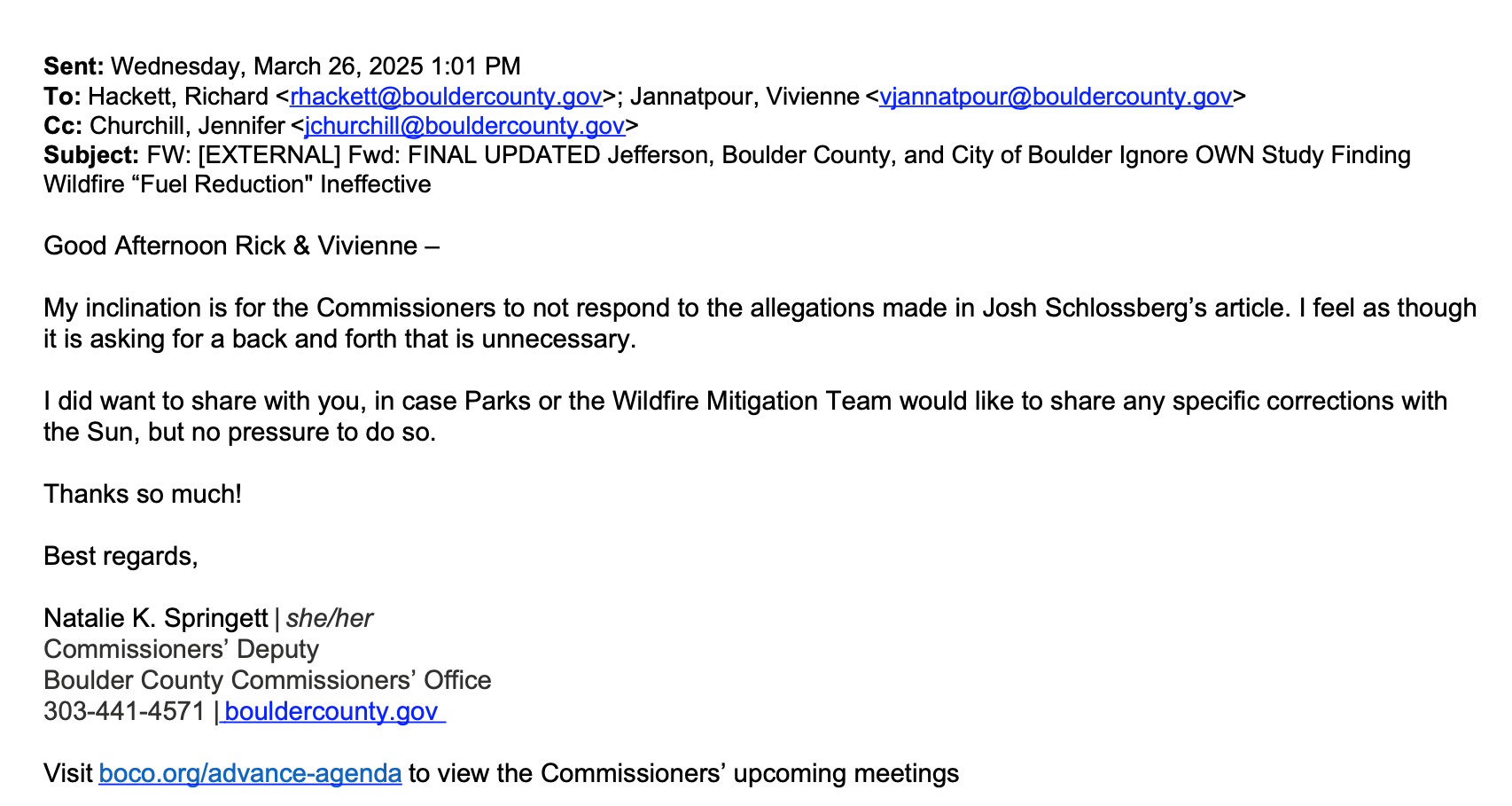
Falsehood: During Boulder County’s presentation, “Forest Resiliency in a Changing Climate,” the Senior Sustainability Strategist for Boulder County’s Office of Sustainability, Climate Action, and Resilience claimed the County was interested in “conversation” and “dialogue” with the public despite years of our local government either dodging or stonewalling conservationists. Indeed, internal emails recently received from a Colorado Open Records Act (CORA) request show an orchestrated county-wide refusal to address critiques from the public or questions from media on this issue (Boulder County’s Office of Sustainability, Climate Action, and Resilience did meet with me on October 1 to discuss concerns, but claimed the logging of Open Space was out of their jurisdiction and ignored all follow-up communications).
Falsehood: The County made the easily disproven unscientific claim that our local forests are net emitters of CO2 instead of our greatest terrestrial buffers to climate change. Based in part on this alarming disinformation perpetuated by the logging industry and fraudulent “reports” from agencies such as the Colorado State Forest Service, the County intends to ramp up logging to supposedly “create” climate resiliency, while in reality exacerbating the climate crisis by releasing more carbon into the atmosphere.
BOULDER WATERSHED COLLECTIVE

Background: Over the last several years, Boulder Watershed Collective has grown from a small nonprofit working on flood recovery to enjoying a multi-million dollar budget thanks to lucrative government contracts and grants to push forward public lands logging (their presentation at the September event revealed them to be accepting taxpayer funding from U.S. Forest Service, despite their executive director insisting to members of the local conservation community during a March meeting that they were not).
Right now, Boulder Watershed Collective is in the final stages of facilitating Boulder County’s near-complete dismissal of the vast majority of public comments the NGO helped solicit on a proposal to log a recently acquired parcel of forest outside Nederland called Tucker Ranch (what they call the “Middle Boulder Creek Fuels Reduction Partnership”). Nearly all the ignored public feedback came in the form of citations from peer-reviewed studies contesting the supposed goals of the project to reduce high-severity wildfire and protect nearby communities.
Falsehood: During its presentation, Boulder Watershed Collective incorrectly asserted that forests surrounding Nederland are “overly dense” “especially at high elevations,” due to “missed fire cycles…[with] more trees than would be historically” which they say are “perpetuating megafires.” To the contrary, local forests around Nederland are in the upper montane zone (7,800’-9,200’). Not only are these lodgepole pine dominated forests well within their historic fire interval of centuries—300-600 years according to the U.S. Forest Service—these forests ecologically require high-severity wildfire (even if some lower montane forest stands are potentially outside of historic fire intervals does not mean all of them are nor that “thinning” is effective at protecting communities or reducing high-intensity fire).
Falsehood: Wrongly stated that they don’t promote clearcutting, when the Tucker Ranch “fuel reduction” they are facilitating for Boulder County involves “patch cuts,” a logging industry euphemism for clearcutting.
Falsehood: Incorrectly declared that carrying out “fuel reduction” in forests makes them less likely to burn at high-severity while admitting that “grasses bounce back.” This ignores the majority of studies showing “fuel reduction” to be ineffective at reducing the effects of weather and wind-driven high-intensity fires as well as scientific findings (including a 2024 study from CU Boulder) proving grassland fires—not forest fires—to be the “fastest-growing and most destructive” blazes threatening communities. Ironically, an abundance of scientific evidence shows “fuel reduction” can actually increase the risk of fires igniting and spreading to communities by removing the canopy, which heats and dries the microclimate and opens the forest to wind spread as well as crown fires.
Falsehood: Insisted that the natural and essential process of wildfire is “damaging” to forests and that forests experiencing them end up as “moonscapes,” when even high-severity wildfire is crucial to many forest ecosystems and almost always recovers.
Falsehood: Claimed to be following “science-based” management despite consistently ignoring the consensus of peer-reviewed science contesting the efficacy of “fuel reduction” in protecting communities and/or mitigating high-intensity wildfire, while frequently promoting long-debunked logging industry talking points.
THE WATERSHED CENTER

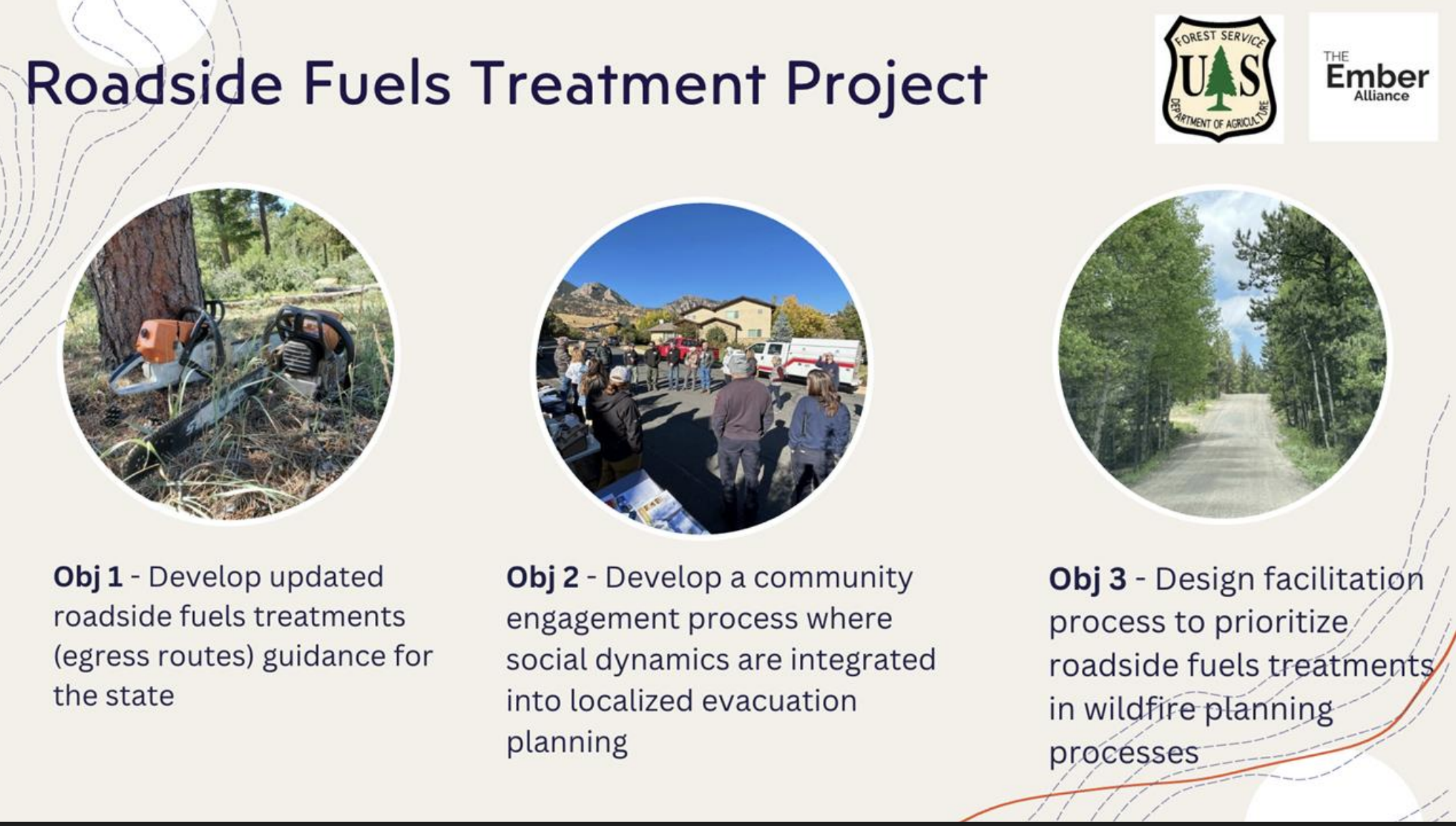
Background: The Watershed Center based in Niwot is funded by the U.S. Forest Service, State of Colorado, Boulder County and other local governments, the timber industry trade group National Forest Foundation, as well as construction, cement, and artificial intelligence corporations to carry out and promote public lands logging. The NGO coordinates the euphemistically named “St. Vrain Forest Health Partnership” which seeks to implement logging across the 625,000 acre St. Vrain Watershed in Boulder County, funded to a tune of over $2.2 million for its Phase 1 alone thus far.
The largely taxpayer-funded Partnership has already logged hundreds of acres of public (and private) forests, including in the supposedly protected Button Rock Preserve adjacent to Hall Ranch Open Space west of Lyons in Boulder County. Photos taken during the 2023 cutting show muddy, eroding logging roads dumping sediment into a stream flowing directly into Longmont Reservoir, drinking water supply for the city’s 98,885 residents.
Falsehood: During its presentation, The Watershed Center incorrectly claimed trees cut in Colorado are “not merchantable” despite 100.9 million board feet logged from Colorado National Forests in 2020, with 80.1 million board feet sold as saw logs, veneer logs, or house logs. Even in County Open Space public lands in the Front Range, logging companies travel from as far away as Oregon—the timber capital of the U.S.—to enter into government contracts to cut trees in the name of “fuel reduction,” while selling some of those logs to mills (larger trees, including mature and old-growth up to 211 years old in Colorado, may be added to the “prescription” to sweeten the deal).
Falsehood: Wrongly stated that the “upper montane zone” begins at 9,000’ when it actually starts at 7,800 feet (the town of Nederland where the event was held sits at 8,228’). While there is evidence that some lower montane forest stands are out of their historic fire interval (whether more trees increase high-severity burning or “thinning” mitigates such fires is still unproven), even Colorado Forest Restoration Institute, which receives government funding to carry out and promote “fuel reduction,” admits that upper montane forests most likely within their historic fire regime.
Falsehood: Implied that only through logging can “forests regrow after fire,” ignoring the obvious fact that forests have not only recovered from high-severity fire for millennia but can require it to thrive.
Falsehood: Referred to vital high-severity fire as “negative fire behavior” despite its normality and ecological necessity.
BOULDER MUSHROOM

Background: While it may seem like a positive thing to “manage excess wood biomass generated from land management operations,” the mission of Boulder Mushroom—which presented at the September event—makes them financially dependent on a perpetuation or even expansion of public lands logging.
On its website, Boulder Mushroom states, “In deforested landscapes, native mycorrhizae can become depleted over time where soil conditions are poor and there is little botanical life.” Yet in contracting with agencies such as Jefferson County Open Space—which is currently carrying out some of the most aggressive “fuel reduction” logging in Colorado and possibly even the entire U.S.—Boulder Mushroom is making at least part of its living cleaning up the mess our governments leave behind.
While Boulder Mushroom certainly has some positive projects it can focus on, during its presentation its founder admitted that they’re looking for “everything we can get funding for.”
[I reached out to Boulder Mushroom for comment, yet they chose not to respond.]
COMMUNITY FOUNDATION BOULDER COUNTY

Background: The September event, “Forest Resiliency in a Changing Climate,” was organized by Community Foundation Boulder County, which has the mission statement of “Responsibly stewarding resources with integrity, transparency, and responsiveness.”
While three members of the foundation’s Environmental Affinity Group were happy to speak to me at the event, the foundation’s director of development repeatedly tried to keep them from doing so. On two occasions as I politely engaged them in mutual conversation, the director escorted them away from me and then chastised me for daring to speak to them at all. The director went on to angrily demand that I not speak to anyone else at the event nor make any spoken public comments during the Q&A section (I was allowed to write a question down on a post-it note which was later read to panelists).
My follow up email to the director after the event sharing my concerns with what I saw as the foundation’s one-sided, unscientific promotion of public lands logging, the exclusion of all wildfire ecologists and conservation advocates from the panel, and lack of professionalism in dealing with an attendee with a different point of view was ignored by her. The vice president of development replied in her stead saying she “will take a look at the report you mentioned and discuss with [the director] when she returns.” Unfortunately, the Community Foundation Boulder County did not follow up.
WILD BEAR NATURE CENTER
Background: The September “Forest Resiliency in a Changing Climate” event was held at the brand new, under-construction Wild Bear Nature Center in Nederland. This massive 8,000 square foot building was cut out of the forest immediately adjacent to Boulder County Open Space’s Mud Lake and Caribou Ranch, both of which have been logged in the name of “fuel reduction,” the latter going against its own management plan to do so in 2023.
Wild Bear continues to bring in a lucrative income with nature-themed events for children, including a summer camp, with a mission of “Inspiring a lifelong connection to nature and community through creative exploration of the outdoors.” On September 27, Wild Bear hosted an “Enchanted Forest” event, charging up to $18 a person for a guided tour through a local forest to “celebrate the magic & mystery of nature.”
Wild Bear receives funding from Boulder County ($150,000 in 2025), on top of millions of dollars from corporate and family foundations, as well as large and small donors.
Falsehood: Over the past year on multiple occasions, members of the conservation community in Nederland and around Boulder County have politely reached out to Wild Bear asking the local nature center to please host at least one event on the full spectrum of peer-reviewed science on “fuel reduction” logging happening in nearby public forests. At the time, Wild Bear leadership insisted they didn’t cover such topics and only did events for children. Yet the organization soon went on to break that promise by hosting multiple events featuring government agencies and other entities that carry out and/or promote public lands logging, while excluding any and all scientists and members of the conservation community questioning such aggressive management in the name of wildfire.
At the September event, Wild Bear Nature Center went so far as to refer to the government-funded facilitator of public lands logging, Boulder Watershed Collective, as a “partner.” In an April 1 email exchange with Wild Bear regarding its plans to host a separate June event for Boulder Watershed Collective on forests and wildfire, its “Lead Nature Educator” said she was “eager to incorporate and highlight some of the elements of it with our oldest group of campers over the course of the summer.”
Another Wild Bear staffer admitted in an April 18 email that “We just want to be a space that the community can learn from the County and from BWC [Boulder Watershed Collective],” while maintaining their refusal to host any scientists or conservationists critical of “fuel reduction” and/or public lands logging.
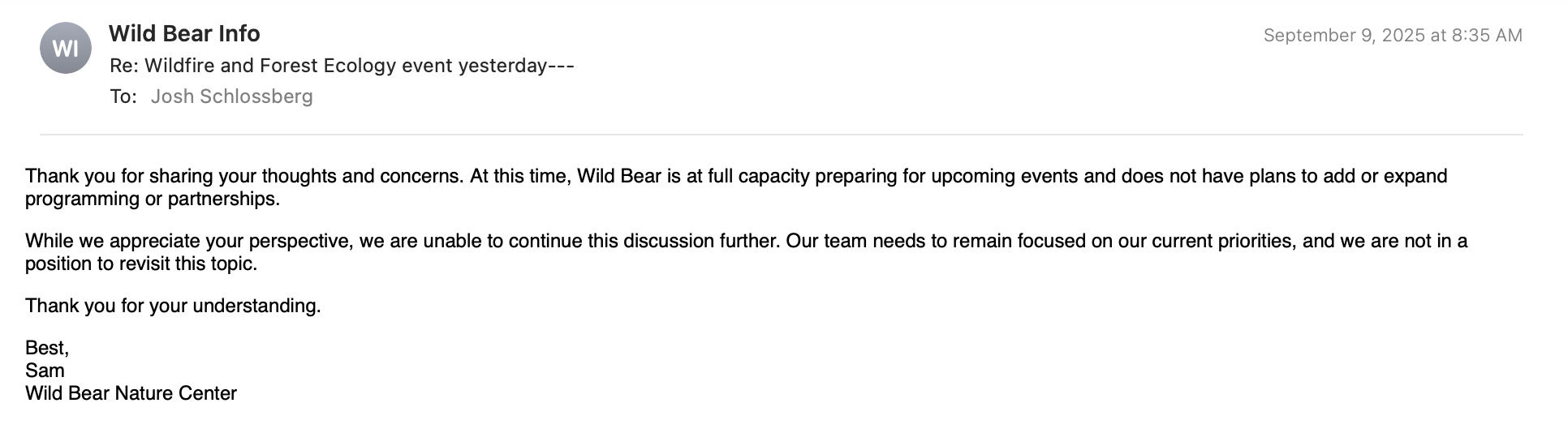
A final email to Wild Bear after the September event asking them to please consider a follow-up event featuring fire ecologists got only this response on September 9: “While we appreciate your perspective, we are unable to continue this discussion further. Our team needs to remain focused on our current priorities, and we are not in a position to revisit this topic.”
Sadly, there was never a “discussion” in the first place, simply Wild Bear Nature Center making promises that turned out to be untrue about not doing events on a crucial topic only to do so to platform government agencies and those carrying out and/or profiting from “fuel reduction” logging, while excluding wildfire ecologists and the local conservation community.
JUSTIN GOLD, FOUNDER OF JUSTIN’S NUT BUTTER
Background: At the September event, Justin Gold, founder of Justin’s nut butter (bought out by Hormel Foods which also owns Dinty Moore, Planters, and SPAM), was present and profusely thanked by Wild Bear Nature Center for his generous financial contributions to their work, and ostensibly the new construction.
It’s unclear whether or not Gold supports the public lands logging promoted at the event. Gold chose not to respond to a polite email sent to him through his company asking if he was familiar with the peer-reviewed science contesting the efficacy of this logging and its impacts to forest ecology and wildlife, along with its potential increase in spreading fire to communities such as Nederland.
CONCLUSION
Even if Boulder County is teaming up with a few NGOs, funders, and businesses to cut apart local forests in the name of ineffective or even counterproductive “fuel reduction,” isn’t it a bit hyperbolic to claim that they’re somehow complicit in “Trump’s assault on public lands?”
Instead of focusing all taxpayer dollars (as opposed to a tiny percent) on scientifically proven home hardening and defensible space pruning up to 100 feet around homes and protecting public lands as Biodiversity, Watershed, and Climate Refugia (the only way for the U.S. to meet international obligations under the Global Biodiversity Framework or climate agreements), the September event reveals that these Boulder County entities don’t only share the same aggressive vision of forest “management” as Trump’s Clearcut Cult, they hide their actions under a thick slathering of greenwash to deceive elected officials, media, and the general public, while refusing to have any meaningful dialogue with those who don’t 100% agree with them.
Tragically, if Trump’s industry-backed, anti-science scheme to commandeer billions in taxpayer dollars to unleash an unprecedented onslaught of public lands logging fools residents of the liberal Blue paradise of Boulder County, I think it’s safe to say that not a single tree anywhere in the entire U.S. is safe from the chainsaws.
Josh Schlossberg is a Boulder County resident living adjacent to the Roosevelt National Forest, an award-winning investigative journalist and science writer, and Colorado Advocate for Eco-Integrity Alliance. His father is a former Forest Service fire lookout and volunteer firefighter.
Contact coloradosmokescreen@proton.me if you’d like to help protect YOUR public lands in Boulder County, Colorado, and beyond.
 The Colorado Smokescreen