

Leadership from “working lands” organizations Conservation Colorado, Western Resource Advocates, and The Nature Conservancy testified alongside industry and government logging interests to help axe a statehouse bill that would’ve routed a small portion of the state’s “wildfire mitigation” funding towards proven home hardening protections through grants to low-income residents, along with seniors and those with disabilities.
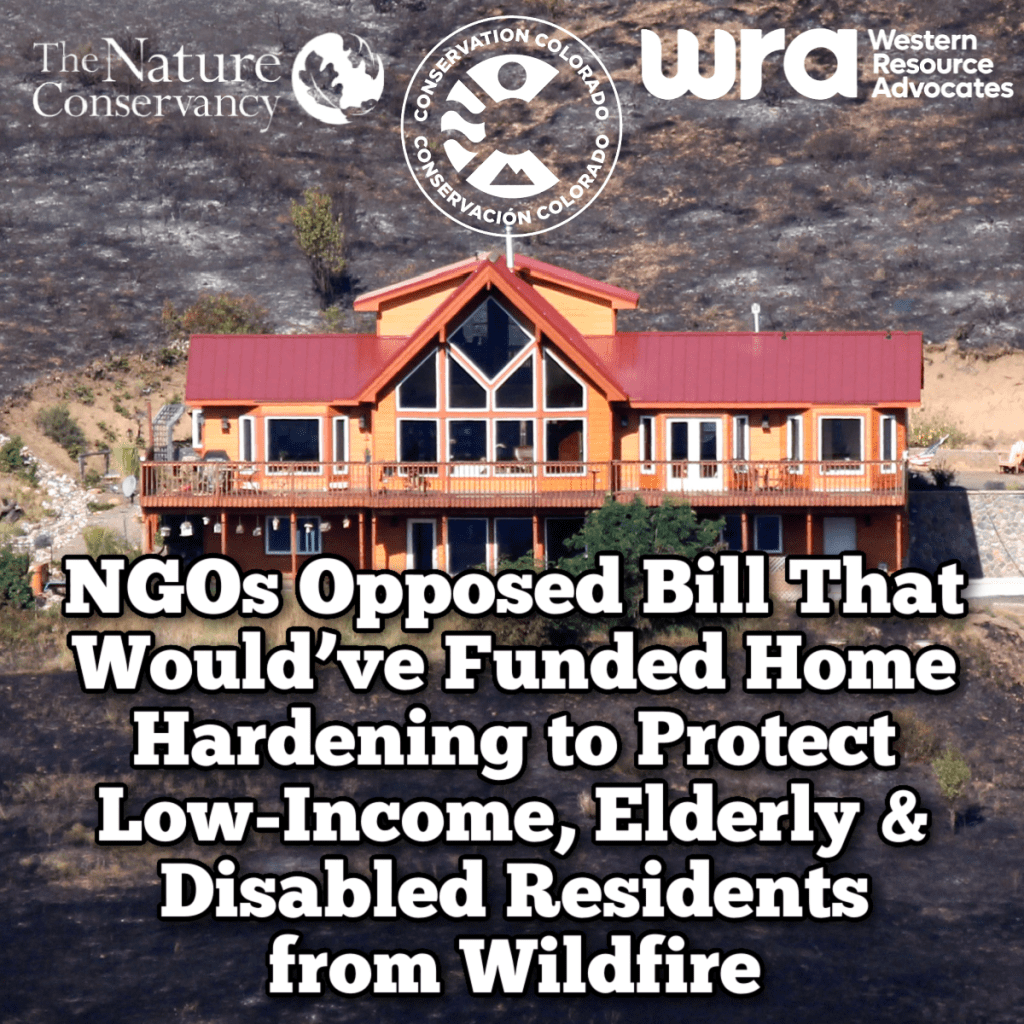
Instead of reimagining the purpose of the “Wildfire Mitigation Capacity Development Fund,” HB-1310 would’ve merely required that the Colorado Department of Natural Resources follow its legal mandate to “prioritize those projects with the greatest potential to protect life, property, and infrastructure,” namely home hardening rather than logging public forests.
Brien Webster, Public Lands Campaign Manager for Conservation Colorado, submitted written testimony to the House Agriculture, Water, and Natural Resources Committee that his organization opposes “sweeping vital funds away from landscape-scale mitigation” towards the consensus science of home hardening. Such scientifically-contested “mitigation” typically includes clearcutting, mature and old-growth tree removal, and logging in endangered species habitat and Roadless Areas.
Brendan Witt, Policy Advisor for Western Resource Advocates, spoke strongly in favor of unrestrained “fuel reduction” logging on public lands and opposed any existing “wildfire mitigation” funding going to protect the property of low-income, elderly, and disabled Coloradans through grants for home hardening.
Rob Addington, Forest and Fire Program Director for The Nature Conservancy, admitted his “working lands” organization—which has a $1.8 billion annual budget—is receiving state funding for “fuel reduction” logging and opposed any decrease in cash flow from Colorado taxpayers.
Addington testified to the Ag Committee that The Nature Conservancy is “directly involved in COSWAP [Colorado Strategic Wildfire Action Program]” and “collaboratives” that get millions in government grants for “fuel reduction” logging.
Addington claimed to support home hardening but not at the “expense” of removing a small portion of taxpayer dollars away from controversial logging. “We value this funding,” Addington said.
In conjunction with opposing “wildfire mitigation” funding for home hardening, Conservation Colorado, The Nature Conservancy, and Western Resource Advocates are promoting a ballot measure that would route a tax on sporting goods to further finance already unprecedented levels of “fuel reduction” logging on Colorado public lands by labeling it as “conservation.”
Twenty Colorado conservation groups—including WildEarth Guardians, Western Watersheds Project, and two Audubon Society chapters, and several other grassroots groups—signed a letter posing twelve questions to Conservation Colorado and Western Resource Advocates about their promotion of an expansion of public lands logging in Colorado, which went ignored.
Corporate foundations such as Pew Charitable Trust (established through oil profits) and the Jeffrey Epstein-linked Gates Foundation have been increasingly bankrolling former “conservation” organizations to abandon land protection in favor of promoting industry extraction on public lands, including logging and ranching.
Currently, nearly a half million acres of “fuel reduction” logging has been announced across the Front Range—with 3.5 million acres on the chopping block (including the four biggest logging projects in state history)—almost entirely unreported by any Colorado media outlets.
“Now we know beyond a shadow of a doubt that those in Colorado promoting logging under the guise of protecting homes like mine from wildfire have zero interest in actually doing so,” says Deanna Meyer, Douglas County resident whose small organic farm is adjacent to Colorado’s second largest logging project in history. “In fact, they’ve proven the opposite: that they staunchly oppose the only measures that would safeguard our communities so they can commandeer all tax dollars towards even more logging to heat up, dry out, and expose forests to wind, which will only spread flames quicker to threaten our homes, livelihoods, and lives.”
 The Colorado Smokescreen
Leave a comment