

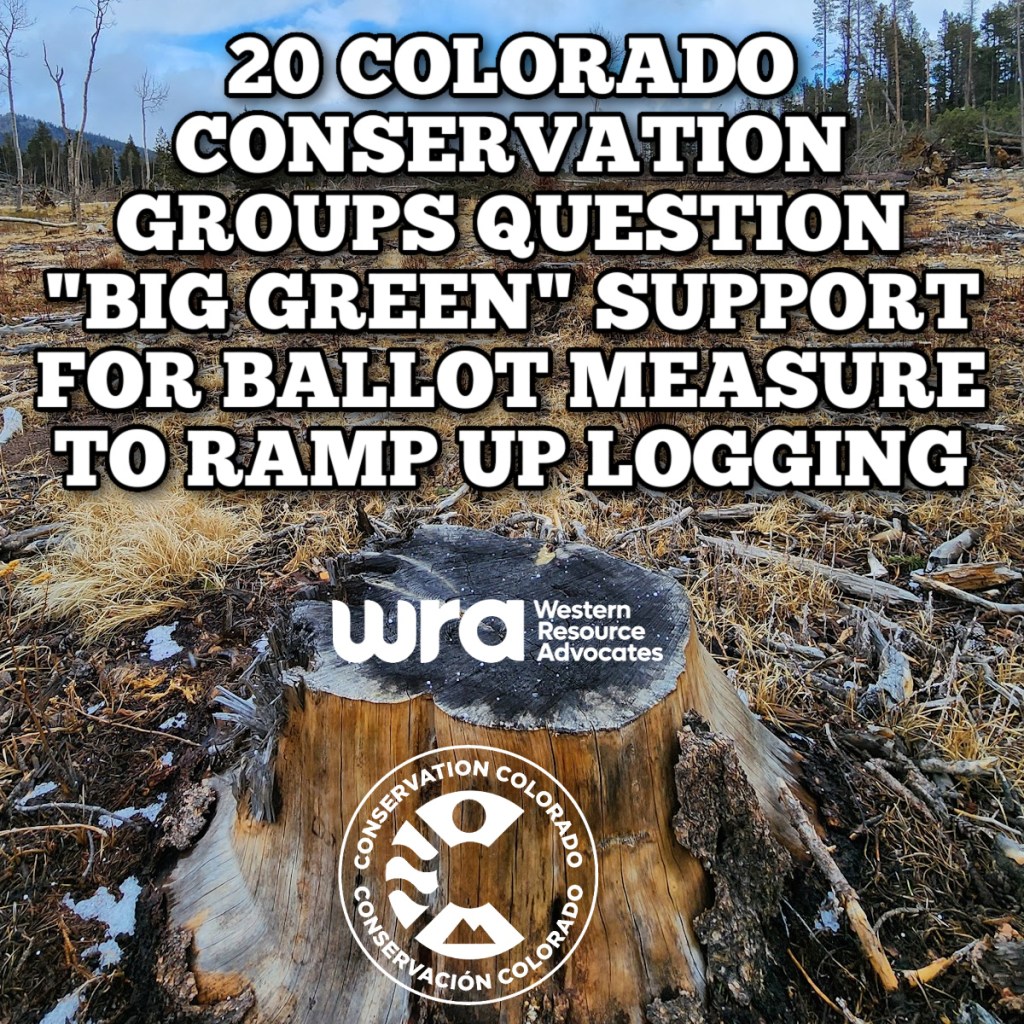
Twenty Colorado conservation groups signed a letter posing twelve questions to Conservation Colorado and Western Resource Advocates about their endorsement (along with The Nature Conservancy) of a ballot measure that would route a tax on sporting goods to further fund already unprecedented levels of “fuel reduction” logging on public lands in the state by framing it as “conservation.”
The letter, co-authored by Eco-Integrity Alliance and Rocky Smith (Denver-based forest management analyst of more than forty years) was signed by WildEarth Guardians, Western Watersheds Project, two Audubon Society chapters, and several other grassroots groups.
“We request that Conservation Colorado and Western Resource Advocates please respond to our questions and clarify why they believe that the proposed initiative is good for Colorado’s forests,” says letter co-author, Rocky Smith.
Many of the signers have emerged as Colorado’s front line conservationists monitoring, questioning, and/or opposing the hundreds of thousands of acres of scientifically-contested “fuel reduction” being carried out across the state (nearly a half-million acres in the Front Range alone). The letter doesn’t take a stance on the initiative, but rather asks Conservation Colorado and Western Resources Advocates whether the funding would include any restrictions for clearcutting, mature and old-growth tree removal, logging in Roadless Areas and/or Endangered Species habitat, or other potential ecological impacts; and whether it would allow public engagement for project planning, including indigenous tribal members; or direct any money towards proven home hardening protections.
Nearly two weeks after the letter was sent via email, neither Conservation Colorado nor Western Resource Advocates has responded to their colleagues’ questions.
Under the initiative, 47.5% of the tax on sporting goods would go to a new “Colorado Wildfire Protection and Water Fund,” 47.5% to the Great Outdoors Colorado (GOCO) program, and 2.5% each to the Outdoor Equity Grant Program and the Outdoor Recreation Economic Development Cash Fund.
The new wildfire fund (Colorado already has several multi-million dollar funding sources for “fuel reduction”) would finance the Colorado State Forest Service and the Colorado Department of Natural Resources to carry out more “wildfire mitigation” efforts, primarily in the form of landscape-wide tree cutting and removal, aka “fuel reduction,” with some of the work done by low-cost prison labor (logging is the most dangerous job in the U.S. according to OSHA).
The taxpayer funding would also be used to “support utilization and marketing of wood products,” to “provide loans to forest products businesses,” and for forest biomass energy. A detailed funding breakdown can be found here.
The consensus of peer-reviewed science concludes that cutting trees in the forest does NOT prevent the spread of fire to communities but can actually increase it. Nor does tree removal usually reduce high-severity wildfire (a weather- and climate-driven phenomenon natural to Colorado’s forest ecosystems) but primarily the lower-intensity fires already easily contained by firefighters and labeled “good fire” by land management agencies and “working lands” NGOs such as The Nature Conservancy.
Widespread logging can also fragment wildlife habitat, lead to the introduction and spread of non-native plants (“weeds”), destabilize watersheds, and invite damaging public motorized use into sensitive areas.
Directing money to efforts that will focus on protecting homes dovetails with the intention of the state’s “Wildfire Mitigation Capacity Development Fund,” which seeks to “prioritize those projects with the greatest potential to protect life, property, and infrastructure.”
For example, on March 2, Rep. Tammy Story (District 25, Jefferson County) introduced HB 26-1310 into the Colorado House of Representatives to reroute a portion of the state’s taxpayer funding away from questionable “fuel reduction” logging towards proven home hardening protections, prioritizing grants to low-income residents along with seniors and those with disabilities. HB 26-1310 will be heard by the Agriculture, Water, and Natural Resources Committee on Monday, March 23
 The Colorado Smokescreen
Leave a comment