

On March 2, Rep. Tammy Story (District 25, Jefferson County) introduced HB 26-1310 into the Colorado House of Representatives to reroute a portion of the state’s “wildfire mitigation” taxpayer funding away from controversial and scientifically-contested “fuel reduction” logging towards proven home hardening protections, prioritizing grants to low-income residents along with seniors and those with disabilities.
Instead of reimagining the purpose of the “Wildfire Mitigation Capacity Development Fund,” the bill would merely require that the Colorado Department of Natural Resources stop shirking its legal mandate to “prioritize those projects with the greatest potential to protect life, property, and infrastructure,” namely home hardening rather than logging forests. HB 26-1310 will be heard by the Agriculture, Water, and Natural Resources Committee on March 16.
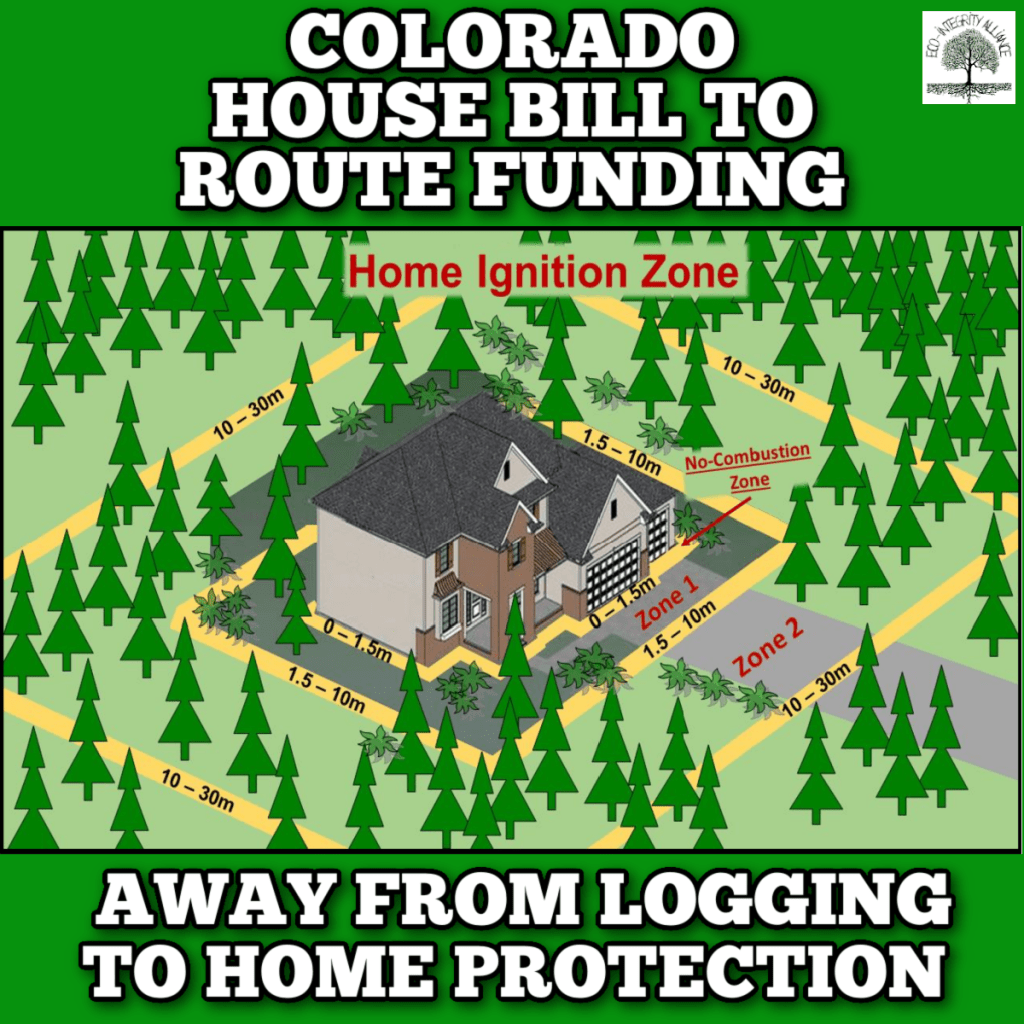
Until now, DNR’s “Wildfire Mitigation Capacity Development Fund” housed under Colorado Department of Natural Resources, has focused on “planning and implementation of fuel reduction and wildfire mitigation projects at landscape-scale,” often exploiting low-pay prison labor to carry out the dangerous industrial-scale logging (logging is the most dangerous job in the U.S. according to OSHA).
Contrary to false claims by the logging/biomass industry and government land management agencies (that require taxpayer dollars for “wildfire mitigation” to fund their budgets), the consensus of peer-reviewed science concludes that cutting trees in the forest does NOT prevent the spread of fire to communities. Nor does tree removal usually reduce high-severity wildfire (a weather- and climate-driven phenomenon natural to all Colorado’s forest ecosystems) but primarily the lower-intensity fires already easily contained by firefighters and labeled “good fire” by the same land management agencies.
To the contrary, studies—including those funded by the U.S. Forest Service which promote more logging—find that cutting trees in the forest dries out and heats up the forest microclimate, making wildfire ignition more likely, while opening tree stands to winds, increasing the risk of spreading fire to communities.
Colorado Forest Restoration Institute at Colorado State University, which advises Colorado land management agencies on wildfire and forest policy, acknowledged in a private email (obtained in a Colorado Open Records Act filing) that “numerous” scientific studies contest the efficacy of “wildfire fuel reduction” and that the U.S. Forest Service “overpromises” results from such logging. Yet CFRI advised agency staff never to admit this to the media or public, warning that “Engaging in toe-to-toe trench warfare with competing science papers would result in stalemate – and win for the opponents” (“opponents” being scientists, ecological advocates, and local residents).
 The Colorado Smokescreen
Leave a comment