

Jefferson County Open Space continues to ignore public opinion, peer-reviewed science, and even its own studies challenging the or effectiveness of—or need for—cutting forests in the name of “community protection” from wildfire, with plans to log 86 acres of popular Beaver Ranch Park outside Conifer starting in July.
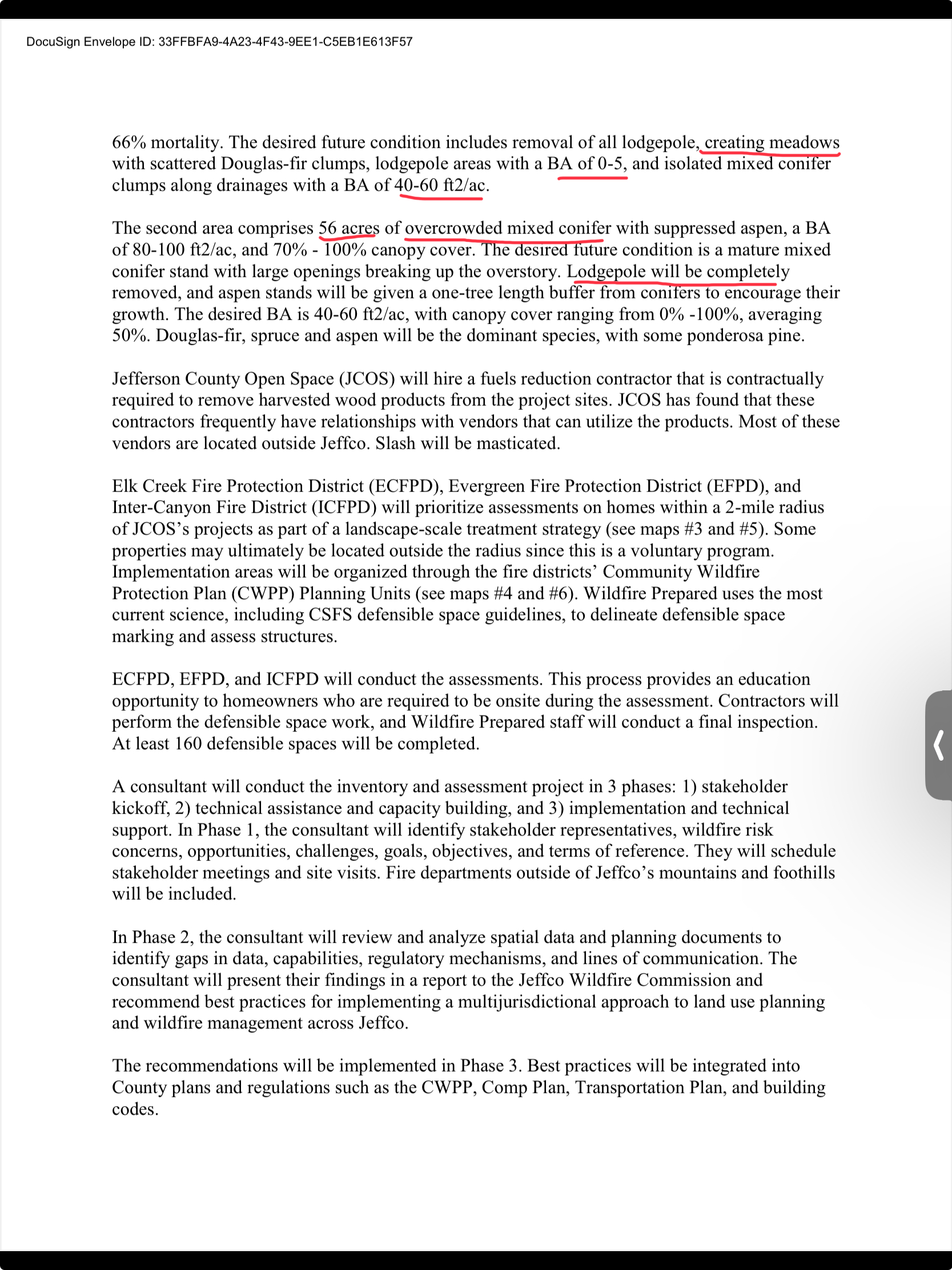
The controversial proposal includes cutting “large trees,” removal of 40 to 75 percent of forest overstory, and clearcutting all lodgepole pine in the two units at a cost of $4,500 per acre, according to Jefferson County Open Space.
While Jefferson County claims this particular forest to be “overcrowded,” to the contrary, the elevation of Beaver Ranch Park (8080 to 8640 feet) falls within the Upper Montane Zone. Even the U.S. Forest Service acknowledges that such lodgepole pine-dominated stands have not been altered by fire suppression as they have a historic fire return interval between 300 to 600 years.
“Any justification for clearcutting Beaver Ranch Park due to its forests supposedly being out of the historic range of wildfire is either a huge error by Jefferson County in need of immediate correction or an intentional fabrication to divert more taxpayer dollars that could be spent on hardening local homes into the pockets of logging corporations,” says Josh Schlossberg, Colorado Advocate for Eco-Integrity Alliance.
Adding insult to injury, a 2022 study by Colorado Forest Restoration Institute found that the questionable goal of “reducing the potential for high severity wildfire” through a 2017 “fuel reduction” project in Beaver Ranch Park was “not met.”
“Understory Response Four Years Following Treatment at Beaver Ranch” concluded that despite hundreds of thousands of taxpayer dollars spent on widespread tree removal, wildlife habitat destruction, soil compaction and erosion, and carbon emissions, models found that “Surface fire behavior remained relatively unchanged through our study period,” and the likelihood of a crown fire barely decreased by 1 percent.
Further, “Four years post-treatment, most surface fuels were at their highest levels,” a 46 percent increase. Meanwhile, “Coarse woody debris increased by 30% after treatment, and remained higher 4 years following treatment.”
Finally, the study warned that the regrowth of seedlings as a result of logging “could act as ladder fuels. Beaver Ranch should be watched closely, as these ladder fuels have the potential to increase fire behavior in the future.”
Upper South Platte Partnership Monitoring Summary from 2021 also found that the previous forest clearing “provided minimal benefits for watershed and community protection, as predicted fire intensity and post-fire tree mortality remained high.”
Another 2022 study funded by Jefferson County, along with City and County of Boulder, found in local forest plots previously “thinned” in the name of “wildfire mitigation” a “lack of clear effectiveness of the treatments at increasing surviving live biomass when exposed to a wildfire.”
Study authors theorized that “partially…the high ground fuel loads and decreased tree density led to increased fire intensity as a result of easier wind movement, an unintended consequence seen in the 2010 Four Mile fire as well.”
The scientific consensus—and easily observed fact—is that tree removal opens cooler, moister forest stands to the drying and heating effects of sunlight, as well as increased wind speed, which can spread fires more rapidly to communities.
“Even Jefferson County’s own studies prove that Beaver Ranch Park’s forests are fine the way they are,” says Schlossberg. “Evidence shows that the County’s taxpayer-funded Frankenstein experiments to try to suppress natural wildfires through logging not only don’t work, they might be increasing the risk to local communities.”
A community survey in the Beaver Ranch Park Master Plan found the majority of users to be “very interested” in hiking trails and “open, undisturbed natural areas for wildlife and wildlife viewing.” Other user comments include a desire for: “preservation of natural areas,” “undisturbed open space for enjoying/learning about nature,” to “protect sensitive habitat,” and to “leave it as is.”
The park—including the popular disc golf course and dog park—would be closed for an undetermined amount of time during the estimated six months of logging.
Jefferson County Commissioners still have time to stop the unnecessary impacts to Beaver Ranch Park by imposing a moratorium on all “fuel reduction” in Open Space until the full body of science and public input is incorporated into decision making (a petition signed by almost 800 people is here). The majority of park users spoken to at trailheads have concerns about the cutting.
 The Colorado Smokescreen
Leave a comment