

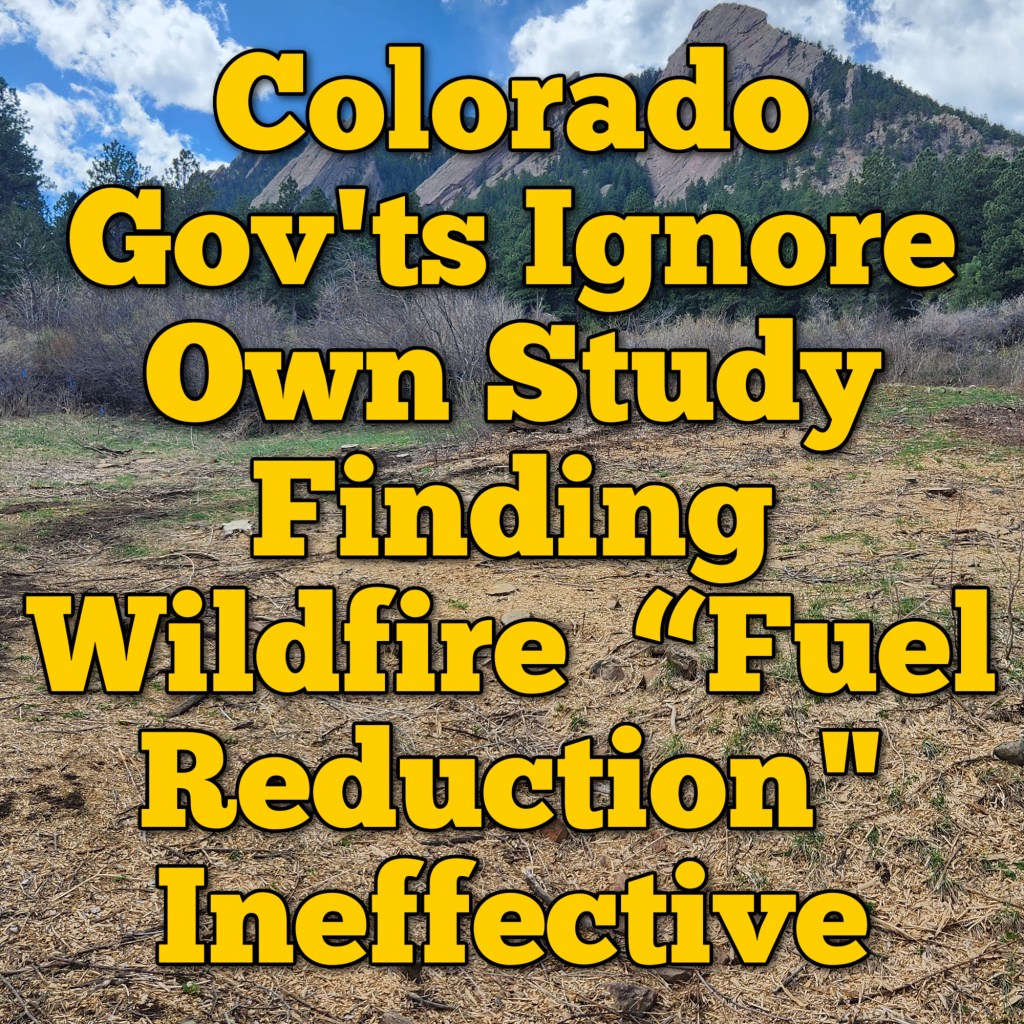
Jefferson County and Boulder Open Space, and the City of Boulder Open Space and Mountain Parks (OSMP) are planning thousands more acres of “fuel reduction” projects this year, ignoring the recommendations of a 2022 study the governments funded concluding that forests “thinned” prior to the 2020 Calwood fire burned at least as intensely (or moreso) as uncut forests and ultimately released more carbon into the atmosphere.
On the acknowledgements on page 18, the study authors wrote, “We thank the City of Boulder, Boulder County, and Jefferson County for funding this research.”
Not only weren’t the findings mentioned in the governments’ since released “Community Wildfire Protection Plans” (Jefferson County, Boulder County, City of Boulder), the study wasn’t even cited in any of the documents’ hundreds of references. This study joins a vast and growing body of peer reviewed science showing the ineffective and often counterproductive nature of “fuel reduction” for protecting communities from wildfire, which has been ignored, denied, downplayed, or distorted by land management agencies, most elected officials, and some media outlets.
The study, “Fuels treatments and their impact on carbon stocks and fire severity in Boulder and Jefferson Counties and the City of Boulder” by climate scientist Brian Buma, Ph.D. and Erin Twaddel from University of Colorado and research scientist Anthony Vorster from Colorado State University in Fort Collins, is mentioned on the City of Boulder website under the heading “OSMP Funded Research Projects” with the stated goal to “improve natural resource management in the area” and can be found on the Boulder County website.
Specifically, the study found in forest plots previously “thinned” in the name of “wildfire mitigation” by Boulder County Open Space, a “lack of clear effectiveness of the treatments at increasing surviving live biomass when exposed to a wildfire.” (Page 14)
Study authors theorize “partially that the high ground fuel loads and decreased tree density led to increased fire intensity as a result of easier wind movement, an unintended consequence seen in the 2010 Four Mile fire as well.”*
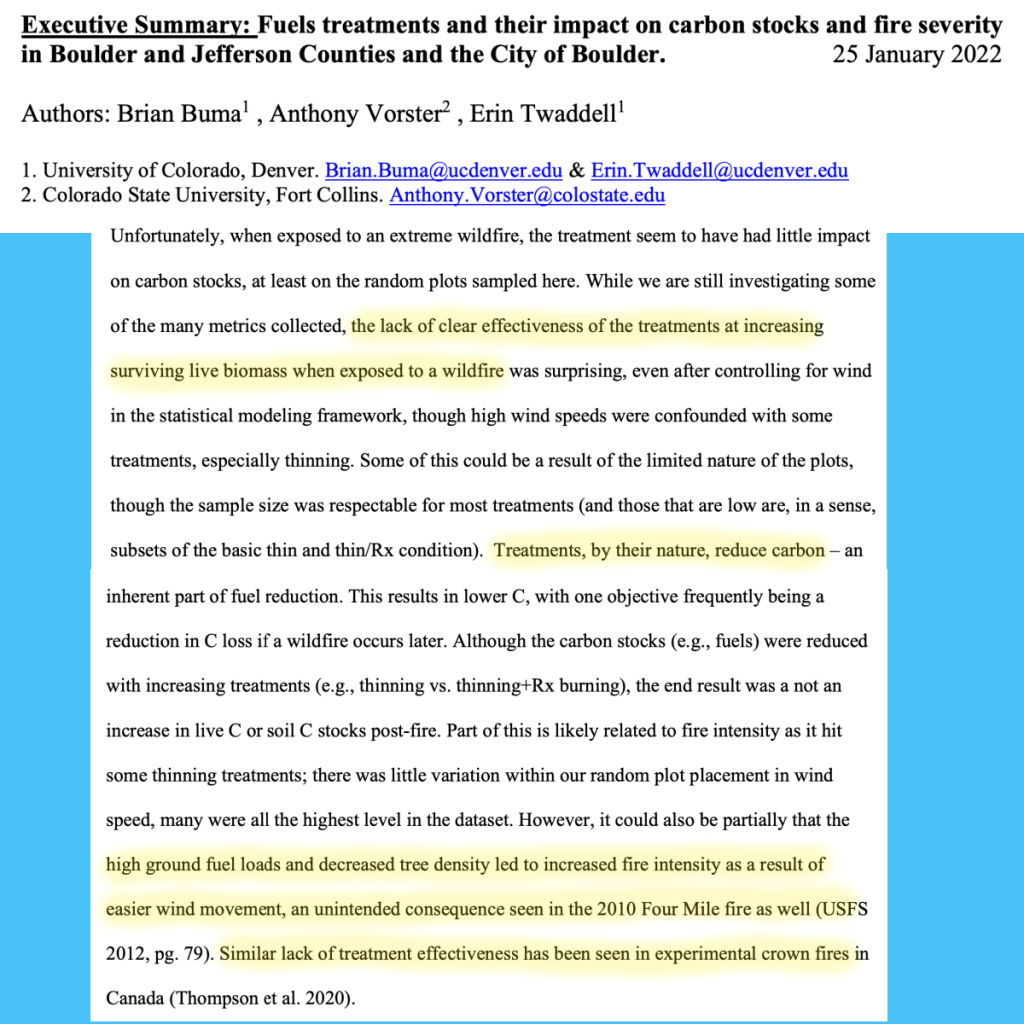
[*(Full quote from Page 15) Part of this is likely related to fire intensity as it hit some thinning treatments; there was little variation within our random plot placement in wind speed, many were all the highest level in the dataset. However, it could also be partially that the high ground fuel loads and decreased tree density led to increased fire intensity as a result of easier wind movement, an unintended consequence seen in the 2010 Four Mile fire as well (USFS 2012, pg. 79). Similar lack of treatment effectiveness has been seen in experimental crown fires in Canada (Thompson et al. 2020).”]
What’s more, “Treated plots had less carbon than untreated wildfire plots,” (Page 1) meaning that less vegetation remained in the “thinned” forest after the fire when compared to the “unthinned” forest, thereby ultimately releasing more CO2 into the atmosphere as the result of the cutting and burning.
Yet, completely ignoring the evidence in—or even the existence of—its own commissioned study, City of Boulder, Boulder County, and Jefferson County continue to push through thousands of acres of taxpayer-subsidized, experimental “fuel reduction” logging in our carbon-storing public forests without meaningful community engagement or much accurate media coverage.
And, still, the only response from Boulder Mayor and City Councilors as well Boulder and Jefferson County Commissioners to environmental advocates, members of the public living adjacent to the cutting, and independent scientists who raise concerns—in the rare instances when there’s a response at all—is that the science is “settled” and that anyone saying otherwise is “misrepresenting” the data or being intentionally dishonest.

 The Colorado Smokescreen
Leave a comment