

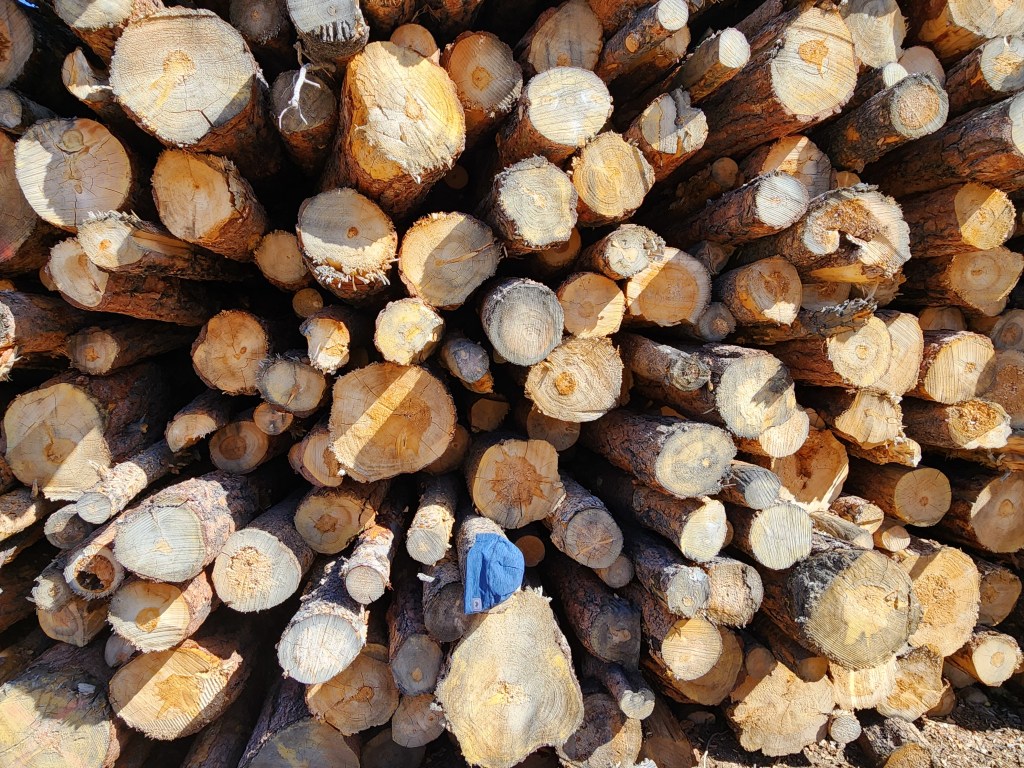
On top of a scheme to log 3.5 million acres of Front Range forests, the U.S. Forest Service is now proposing to cut nearly 800,000 acres of carbon-storing national forests—including old growth—in western and north-central Colorado.
In 2022, the U.S. Forest Service announced plans to log up to 3.5 million acres of forests in Colorado’s Front Range under the premise of “wildfire fuel reduction,” despite numerous scientific studies disproving the reasoning for and effectiveness of this logging, including from wildfire ecologists at CU Boulder. [1][2]
In August, the Forest Service unveiled the Grand Mesa, Uncompahgre, and Gunnison Forest Plan Revision, putting over 772,000 acres of West Slope public forests—including mature and old-growth trees—on the chopping block, including up to 326,000 acres of unscientific “wildfire fuel reduction” logging. [3]
This would be an 66% increase from current high levels of logging in these forests, with Forest Service admitting that the area is already “one of the largest commercial timber-producing forests in the Rocky Mountain Region.”
While conservation groups had called for 324,000 acres of new wilderness, the Plan Revision recommends only 46,200. Once an acreage is logged, including for “wildfire fuels,” it is unlikely to qualify for wilderness protection.
In September, the Yampa Ranger District of the Medicine Bow–Routt National Forest in Routt County near Steamboat Springs announced the South Routt Fuels Reduction, nearly 11,000 acres of “wildfire fuels” logging. [4] To expedite the cutting, the Forest Service is pursuing a controversial “emergency action” as laid out under Section 40807 of the Infrastructure Investment and Jobs Act of 2021, which would allow the agency to bypass certain legal challenges used by environmental advocates to pause or stop destructive logging. [5]
Over the last six months alone, 12 of these “emergency action” logging projects have been scheduled across 6 states—over 600,000 acres total—with the stated goal of eventually logging over 45 million acres across the West. [6]
Billions of taxpayer dollars have already been spent on this scientifically contested “wildfire fuels logging,” with Colorado’s delegation of Senator Michael Bennet (D), Senator John Hickenlooper (D), and Rep. Joe Neguse (D) acting as the most aggressive cheerleaders in Congress. In February, Sen. Bennet proposed legislation to spend an additional $60 billion on the controversial scheme. [7]
The scientific consensus, including from the Forest Service’s own Rocky Mountain Research Station Fire Sciences Laboratory, is that hardening homes—measures such as installing metal roofs and maintaining defensible space 15-60 feet around structures—can save the vast majority of homes from the most intense wildfires. [8][9]
[1] https://www.fs.usda.gov/sites/default/files/WCS-Initial-Landscape-Investments.pdf
[2] https://www.mdpi.com/2571-6255/6/4/146
[3] https://www.fs.usda.gov/Internet/FSE_DOCUMENTS/fseprd642150.pdf
[4] https://www.fs.usda.gov/project/mbr/?project=64833
[5] https://www.congress.gov/117/plaws/publ58/PLAW-117publ58.pdf
[6] https://www.congress.gov/118/meeting/house/115437/witnesses/HHRG-118-AP06-Wstate-MooreR-20230323.pdf
[7] https://www.bennet.senate.gov/public/index.cfm/2023/2/bennet-crow-introduce-protect-the-west-act-to-combat-intensifying-wildfires-and-drought-across-the-american-west
[8] https://www.fs.usda.gov/research/treesearch/4692
[9] https://www.publish.csiro.au/wf/WF13158
 The Colorado Smokescreen
Leave a comment