

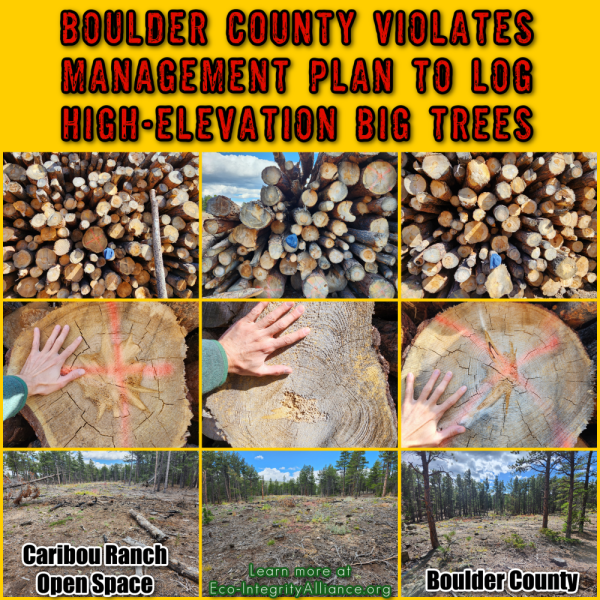
This spring, Boulder County logged hundreds of large, mature, fire-resistant conifers in Caribou Ranch Open Space 1.5 miles outside of Nederland in violation of its own management plan. [1]
“Caribou Ranch & Sherwood Gulch Fuels Reduction” involved 100-acres of controversial, scientifically-contested “wildfire risk reduction” logging at the popular 2,180 acre park which sits an elevation of 8,300 to 10,000 feet. Stated objectives were to “reduce overstory density, remove ladder fuels, and establish a forest structure that is more resilient to wildfire.” [2]
The county’s justification for cutting trees is the common claim that a century of industry/agency fire suppression has created “overly dense,” “unhealthy” forests that must be logged to prevent wildfire. Yet, the “Caribou Ranch Open Space Management Plan” acknowledges the park’s fire interval to be 150 years or greater, reaching the conclusion that “today’s forests are within the historical range of variability.” [3]
Further, Boulder County admits in its document that “regional climate appears to be the most important factor in the large-scale forest fires that influence this area rather than the buildup of fuels.”
Finally, the county warns cautions about impacts of logging, pointing out that “thinning lodgepole pine and spruce-fir forests tends to simplify the forest structure and removes important ecological components.”
Yet, Boulder County chose to ignore its own findings about fire intervals, “fuels,” and the harms of logging by cutting and removing roughly a thousand trees from the forest, including some of the largest, most fire-resistant conifers.
Contesting the industry/agency conventional wisdom, independent (i.e. non-agency-funded) studies determine that not only won’t logging stop large wildfires, it can make them burn hotter and spread faster by opening forests to sunlight and wind. [4]
Indeed, the entire premise of logging to create “historical conditions” of parklike forests due to “overgrown” stands and “unusual” high-severity wildfire has been repeatedly debunked by multiple studies in peer-reviewed journals. Contrary to the industry/agency narrative, these studies find that western forests—including in Colorado’s Front Range—prior to fire suppression did grow densely and did experience high-severity wildfire. [5]
“Boulder County is violating its own management plan to spend our tax dollars on destructive logging that studies show not only won’t protect communities from large wildfires but can actually make those fires burn hotter and spread faster,” says Josh Schlossberg, Boulder County resident and Colorado organizer for Eco-Integrity Alliance. “Therefore, we’re calling for an immediate moratorium on all so-called ‘wildfire risk reduction’ logging on county open space until independent scientists and concerned citizens are allowed to meaningfully engage in the decision-making process.”
The mission of Eco-Integrity Alliance is to unite the grassroots environmental movement through common campaigns of mutual support. More at Eco-IntegrityAlliance.org.
[1] https://drive.google.com/drive/folders/1Pqoox5n-cGUoDiDYM2HVxwazjxnj0BZU?usp=sharing
[2] https://bouldercounty.gov/open-space/management/caribou-sherwood-gulch-forestry-project/
[3] https://assets.bouldercounty.gov/wp-content/uploads/2017/03/caribou-ranch-management-plan.pdf
 The Colorado Smokescreen
Leave a comment